
Review the key concepts, formulae, and examples before starting your quiz.
🔑Concepts
Perimeter is the total distance around the outside of a shape. For a rectangle, it is the sum of all four sides: .
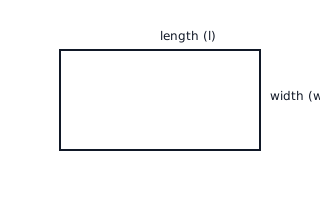
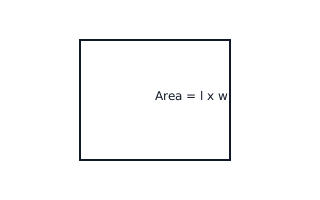
Area is the amount of space inside a 2D shape. For a rectangle, it is calculated by multiplying the length by the width ().
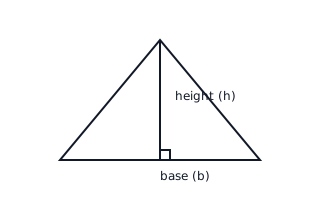
The area of a triangle is half the area of a rectangle with the same base and height. The height MUST be the perpendicular distance from the base to the opposite vertex.
When calculating perimeter or area, ensure all measurements are in the same units (e.g., all cm or all m). Standard units for area are squared units like or .
📐Formulae
Perimeter of a Rectangle: or
Area of a Rectangle:
Area of a Triangle:
Perimeter of a Triangle:
💡Examples
Problem 1:
Find the area and perimeter of a rectangle with a length of 8 cm and a width of 5 cm.
Solution:
Perimeter = , Area =
Explanation:
To find the perimeter, add length and width and multiply by 2: . To find the area, multiply length by width: .
Problem 2:
A triangle has a base of 10 cm and a perpendicular height of 6 cm. Calculate its area.
Solution:
Area =
Explanation:
Using the formula , we get . , and half of 60 is .
Problem 3:
A rectangular garden has an area of . If the length is , find the width and then calculate the perimeter.
Solution:
Width = , Perimeter =
Explanation:
First, find the width using : . Then calculate the perimeter using : .
Problem 4:
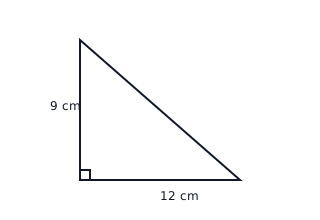
Calculate the area of the right-angled triangle shown below, where the base is and the height is .
Solution:
Explanation:
To find the area of a triangle, identify the base and the perpendicular height. Substitute these values into the formula and multiply, then divide by 2.
Problem 5:
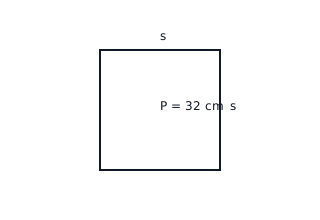
A square has a perimeter of . Find the area of the square.
Solution:
Step 1: Find the length of one side ():
Step 2: Calculate the area ():
Explanation:
A square has four equal sides. First, divide the perimeter by 4 to find the length of one side. Then, square that length to find the area.