
Review the key concepts, formulae, and examples before starting your quiz.
🔑Concepts
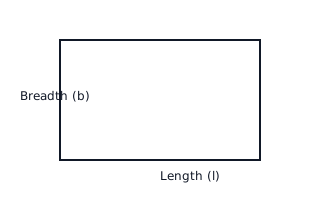
The area of a rectangle represents the total surface covered by it in a two-dimensional plane. It is calculated by multiplying its dimensions: .
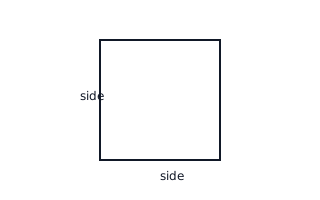
A square is a special rectangle where all sides are equal. Therefore, its area is the product of its sides: .
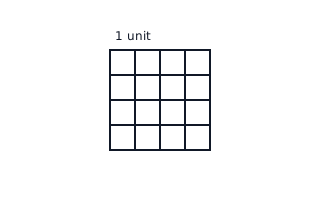
Area is always measured in square units, such as , , or . When solving problems, ensure all dimensions are in the same unit before calculation.
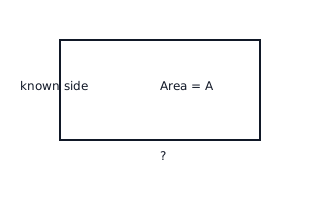
To find a missing dimension (length or breadth) of a rectangle when the area and one side are known, use division: or .
📐Formulae
💡Examples
Problem 1:
A rectangular floor is long and wide. Calculate the cost of carpeting the floor if the rate of carpeting is per square meter.
Solution:
Step 1: Identify the given values. Length () = Breadth () =
Step 2: Calculate the area of the rectangular floor.
Step 3: Calculate the total cost.
Final Answer: The cost of carpeting is .
Explanation:
First, we find the total surface space (area) of the floor using the rectangle formula. Then, we multiply this area by the cost per unit area to find the total expense.
Problem 2:
The area of a square plot is . Find the length of its side and also calculate its perimeter.
Solution:
Step 1: Find the side of the square.
Step 2: Calculate the perimeter of the square.
Final Answer: The side of the plot is and the perimeter is .
Explanation:
We use the inverse of the area formula (square root) to find the length of one side. Once the side is known, we multiply it by 4 to find the total boundary length (perimeter).
Problem 3:
A square tile has a side of . How many such tiles are required to cover a rectangular floor of length and breadth ?
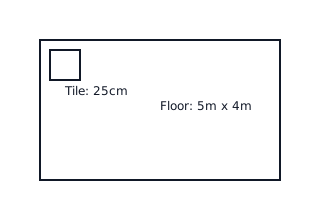
Solution:
Explanation:
First, find the area of the rectangular floor and the square tile. Ensure units match (convert meters to centimeters). Then, divide the total floor area by the area of a single tile to find the quantity.
Problem 4:
Find the area of a rectangular garden if its breadth is and its length is three times its breadth.
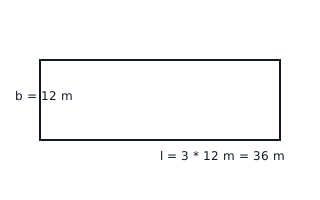
Solution:
Explanation:
First, calculate the length based on the given ratio (3 times the breadth). Then, multiply the calculated length by the given breadth to find the area.