krit.club logo

Perimeter and Area - Area of a Triangle

Grade 6CBSE

Review the key concepts, formulae, and examples before starting your quiz.

🔑Concepts

•

The area of a triangle is the region enclosed within its three sides. It is exactly half the area of a parallelogram with the same base and height.
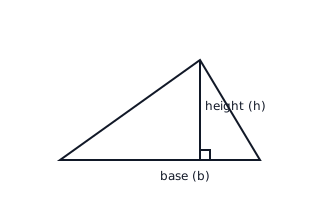
Triangle showing base and height
•

The base can be any side of the triangle. The height (or altitude) is the perpendicular distance from the opposite vertex to that base.
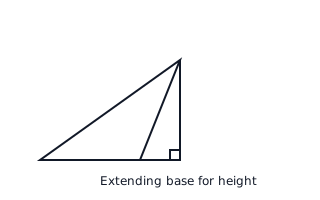
Obtuse triangle showing height outside the base
•

In a right-angled triangle, the two sides containing the right angle serve as the base and the height.

•

The unit of area is always in square units, such as cm2cm^2 or m2m^2.

📐Formulae

Area of a Triangle=12×base×height\text{Area of a Triangle} = \frac{1}{2} \times \text{base} \times \text{height}

Area=12×b×h\text{Area} = \frac{1}{2} \times b \times h

Base(b)=2×Areaheight\text{Base} (b) = \frac{2 \times \text{Area}}{\text{height}}

Height(h)=2×Areabase\text{Height} (h) = \frac{2 \times \text{Area}}{\text{base}}

💡Examples

Problem 1:

Find the area of a triangle whose base is 12 cm12 \text{ cm} and height is 7 cm7 \text{ cm}.

Solution:

Base (b)=12 cmHeight (h)=7 cmArea=12×b×hArea=12×12×7Area=6×7Area=42 cm2\begin{aligned} \text{Base } (b) &= 12 \text{ cm} \\ \text{Height } (h) &= 7 \text{ cm} \\ \text{Area} &= \frac{1}{2} \times b \times h \\ \text{Area} &= \frac{1}{2} \times 12 \times 7 \\ \text{Area} &= 6 \times 7 \\ \text{Area} &= 42 \text{ cm}^2 \end{aligned}

Explanation:

Substitute the given values of base and height into the formula and simplify to find the area.

Problem 2:

The area of a triangle is 36 cm236 \text{ cm}^2. If its height is 9 cm9 \text{ cm}, find the length of its base.

Solution:

Area=36 cm2Height (h)=9 cmBase (b)=2×Areahb=2×369b=729b=8 cm\begin{aligned} \text{Area} &= 36 \text{ cm}^2 \\ \text{Height } (h) &= 9 \text{ cm} \\ \text{Base } (b) &= \frac{2 \times \text{Area}}{h} \\ b &= \frac{2 \times 36}{9} \\ b &= \frac{72}{9} \\ b &= 8 \text{ cm} \end{aligned}

Explanation:

To find the base when area and height are known, multiply the area by 22 and divide the result by the height.

Problem 3:

In a right-angled triangle, the sides containing the right angle are 5 cm5 \text{ cm} and 12 cm12 \text{ cm}. Find its area.

Solution:

Base (b)=5 cmHeight (h)=12 cmArea=12×5×12Area=5×6Area=30 cm2\begin{aligned} \text{Base } (b) &= 5 \text{ cm} \\ \text{Height } (h) &= 12 \text{ cm} \\ \text{Area} &= \frac{1}{2} \times 5 \times 12 \\ \text{Area} &= 5 \times 6 \\ \text{Area} &= 30 \text{ cm}^2 \end{aligned}

Explanation:

In a right-angled triangle, the two sides forming the right angle can be taken as the base and the height.

Problem 4:

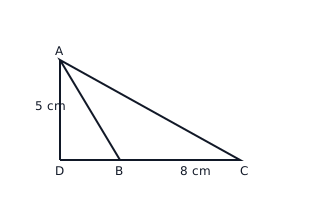
Find the area of an obtuse-angled triangle ABCABC where the base BC=8 cmBC = 8 \text{ cm} and the corresponding height ADAD (measured outside the triangle) is 5 cm5 \text{ cm}.

Obtuse triangle ABC with height AD

Solution:

Base (b)=8 cm\text{Base } (b) = 8 \text{ cm} Height (h)=5 cm\text{Height } (h) = 5 \text{ cm} Area of △ABC=12×b×h\text{Area of } \triangle ABC = \frac{1}{2} \times b \times h Area=12×8×5\text{Area} = \frac{1}{2} \times 8 \times 5 Area=4×5=20 cm2\text{Area} = 4 \times 5 = 20 \text{ cm}^2

Explanation:

To find the area, we identify the base and the vertical height. Even if the height falls outside the triangle, we use the same formula.

Problem 5:

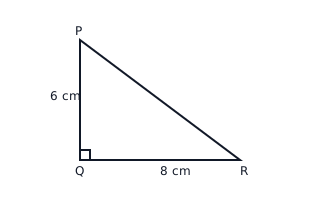
Calculate the area of the given right-angled triangle PQRPQR where PQ=6 cmPQ = 6 \text{ cm} and QR=8 cmQR = 8 \text{ cm}.

Right-angled triangle PQR

Solution:

In △PQR,∠Q=90∘\text{In } \triangle PQR, \angle Q = 90^{\circ} Base (QR)=8 cm\text{Base } (QR) = 8 \text{ cm} Height (PQ)=6 cm\text{Height } (PQ) = 6 \text{ cm} Area=12×Base×Height\text{Area} = \frac{1}{2} \times \text{Base} \times \text{Height} Area=12×8×6\text{Area} = \frac{1}{2} \times 8 \times 6 Area=4×6=24 cm2\text{Area} = 4 \times 6 = 24 \text{ cm}^2

Explanation:

In a right triangle, the two sides forming the 90∘90^{\circ} angle are the base and height.