
Review the key concepts, formulae, and examples before starting your quiz.
🔑Concepts
An angle is formed when two rays meet at a common endpoint called the vertex. We measure the amount of turn between these two rays in degrees () using a protractor.
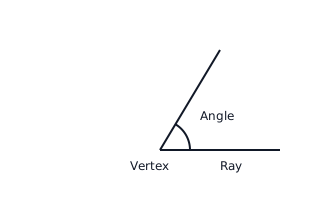
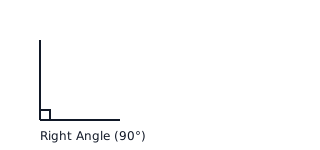
Angles are classified based on their size: Acute angles are less than , Right angles are exactly , Obtuse angles are between and , and Reflex angles are greater than but less than .
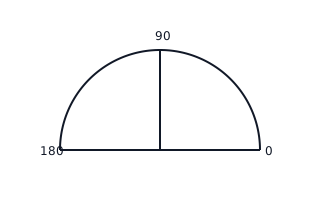
To measure an angle, place the center of the protractor on the vertex and align the zero line with one ray. Read the scale where the second ray crosses the protractor.
A full turn or a circle measures exactly . This represents the sum of angles around a single point.
📐Formulae
💡Examples
Problem 1:
Calculate the missing angle on a straight line if the adjacent angle is .
Solution:
Explanation:
Since angles on a straight line must sum to , we subtract the given angle from to find the unknown value.
Problem 2:
An angle measures . Classify this angle and explain why.
Solution:
The angle is a Reflex Angle.
Explanation:
By definition, any angle that is greater than but less than is classified as a reflex angle. Since , it fits this category.
Problem 3:
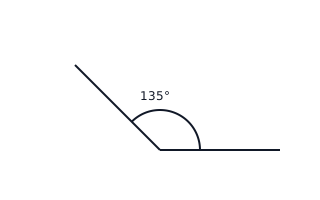
Identify the type of angle shown in the diagram and measure its size if one ray points to and the other points to on the protractor.
Solution:
The angle measures . Since is greater than but less than , it is an obtuse angle.
Explanation:
We compare the measured angle to the benchmark of . Because it is 'wider' than a square corner but 'narrower' than a straight line, it fits the definition of an obtuse angle.
Problem 4:
Find the missing angle if it combines with a angle to form a perfect right angle.
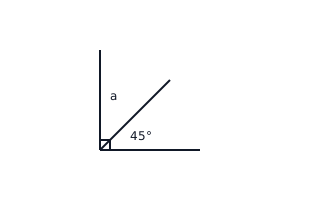
Solution:
Explanation:
A right angle is exactly . If one part is , we subtract that from to find the remaining part.