
Review the key concepts, formulae, and examples before starting your quiz.
🔑Concepts
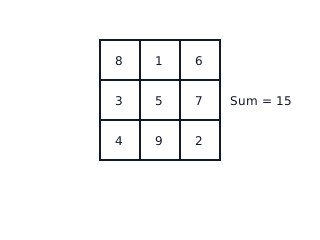
A Magic Square is a grid where the sum of numbers in every row, column, and diagonal is the same. This constant total is called the Magic Sum.
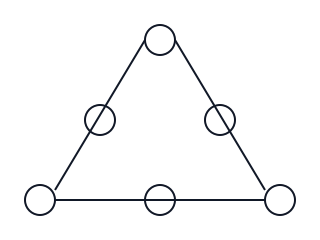
A Magic Triangle is formed by placing numbers in circles on the sides of a triangle. The sum of the numbers on each side of the triangle is equal.
In a magic square, the middle number is always exactly one-third of the Magic Sum. For example, if the sum is , the middle number must be .
The numbers at the corners of a Magic Triangle are counted twice when summing up all the sides. To find a specific sum, strategic placement of the largest or smallest numbers at the corners is key.
📐Formulae
💡Examples
Problem 1:
Complete a magic square using numbers from 46 to 54. The Magic Sum is 150.
Solution:
- Find the middle number of the sequence 46, 47, 48, 49, 50, 51, 52, 53, 54. The middle number is .
- Place in the center cell.
- Check the rule: . This is correct.
- Place the remaining numbers such that each row, column, and diagonal adds to 150.
- Top row:
- Middle row:
- Bottom row:
- Check diagonal: .
Explanation:
By placing the median of the sequence in the center and balancing the largest numbers with the smallest numbers on opposite sides, we satisfy the magic sum requirement for all directions.
Problem 2:
Arrange the numbers 1, 2, 3, 4, 5, and 6 in a Magic Triangle so that the sum of each side is 9.
Solution:
- Sum of all numbers provided: .
- Target sum for 3 sides: .
- Find the sum of corner numbers: .
- Identify three numbers from the set {1, 2, 3, 4, 5, 6} that add up to 6. These are .
- Place 1, 2, and 3 at the corners of the triangle.
- Find the middle numbers for each side:
- Side between corners 1 and 2: .
- Side between corners 2 and 3: .
- Side between corners 3 and 1: .
- The sides are , , and . All sum to 9.
Explanation:
The 'extra' sum needed to reach the side totals comes from the corner numbers being counted twice. By calculating that the corners must sum to 6, we correctly identify 1, 2, and 3 as the vertex numbers.
Problem 3:
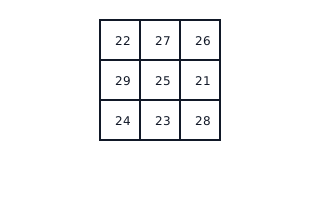
Fill in the missing numbers in the Magic Square below so that every row, column, and diagonal adds up to . The numbers already present are and in the middle row, and in the bottom middle cell.
Solution:
- Identify the middle number: Since the Magic Sum is , the middle number is .
- Calculate top-middle: Bottom-middle is and center is . To make the middle column sum to : .
- Calculate middle-left: Center is and middle-right is . To make the middle row sum to : .
- Continue using the sum of for remaining cells.
Explanation:
We used the property that the center number is of the Magic Sum () and then solved for individual lines where two numbers were known.
Problem 4:
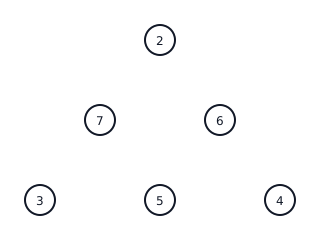
Arrange the numbers in a Magic Triangle such that the sum of each side is .
Solution:
- Place the numbers at the corners.
- Side 1: Between corner and , place . Total: .
- Side 2: Between corner and , place . Total: .
- Side 3: Between corner and , place . Total: .
Explanation:
To achieve a smaller sum like , the smallest numbers () are placed at the corners as they are shared by two sides.