
Review the key concepts, formulae, and examples before starting your quiz.
🔑Concepts
The First Quadrant is the area of a coordinate grid where both the (horizontal) and (vertical) values are positive. The grid begins at the origin .
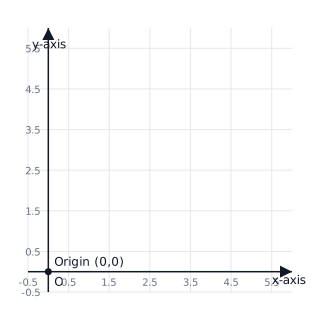
Coordinates are written as an ordered pair . The first number () tells you how far to move along the horizontal axis, and the second number () tells you how far to move up the vertical axis. Remember: 'Along the corridor and up the stairs'.
The x-coordinate represents the horizontal position. Moving right increases the value, while moving left decreases it.
The y-coordinate represents the vertical position. Moving up increases the value, while moving down decreases it.
To plot a point like , you start at , move units to the right, and then units up.
📐Formulae
💡Examples
Problem 1:
A point is located 5 units to the right of the origin and 3 units up. Write its coordinates.
Solution:
(5, 3)
Explanation:
The first number (x) represents the horizontal distance from the origin (5), and the second number (y) represents the vertical distance (3).
Problem 2:
Start at point (2, 4). Move 3 units to the right and 1 unit down. What are the new coordinates?
Solution:
(5, 3)
Explanation:
Moving right increases the x-value: . Moving down decreases the y-value: .
Problem 3:
Points are plotted at (1, 1), (1, 5), and (5, 5). If these are three corners of a square, what is the coordinate of the fourth corner?
Solution:
(5, 1)
Explanation:
To complete the square, the fourth point must be on the same horizontal level as (1, 1), meaning , and the same vertical line as (5, 5), meaning .
Problem 4:
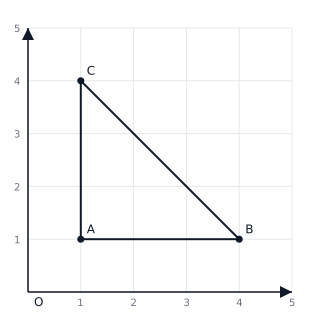
Identify the coordinates of the vertices for the triangle plotted on the grid.
Solution:
,
Explanation:
Point is unit right and unit up. Point is units right and unit up. Point is unit right and units up.
Problem 5:
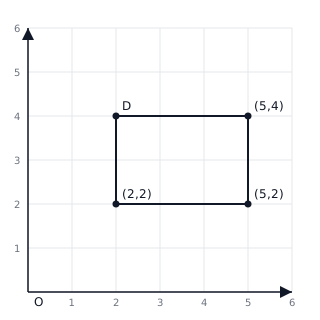
A rectangle has vertices at , , and . What are the coordinates of the fourth vertex to complete the rectangle?
Solution:
Explanation:
In a rectangle, opposite sides are equal and parallel. The bottom side goes from to at . The right side goes from to at . To close the shape, we must go from back to at the height .