
Review the key concepts, formulae, and examples before starting your quiz.
🔑Concepts
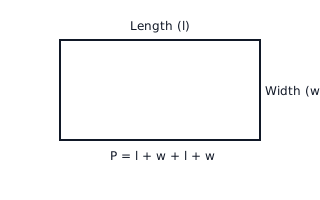
Perimeter is the total distance around the outside edge of a 2D shape. For a rectangle, it is the sum of all four sides ().
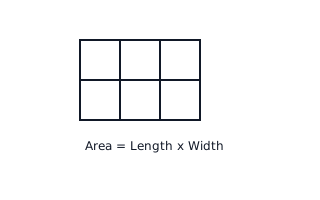
Area is the amount of surface space inside a shape, measured in square units (like or ). It is calculated by multiplying the length by the width.
A square is a special type of rectangle where all four sides are equal. Therefore, the Area = and the Perimeter = .
When measuring perimeter, use linear units (e.g., , ). When measuring area, use square units (e.g., , ).
📐Formulae
Perimeter of a Rectangle: or
Area of a Rectangle:
Perimeter of a Square:
Area of a Square:
💡Examples
Problem 1:
A rectangular rug has a length of and a width of . Find its perimeter and area.
Solution:
-
To find the Perimeter ():
-
To find the Area ():
Explanation:
We identify the length () and width (). For perimeter, we add the sides and double the sum. For area, we multiply the two dimensions together. Note the different units: for perimeter and for area.
Problem 2:
A square photo frame has a side length of . Calculate the total length of wood needed for the frame and the space the photo occupies.
Solution:
-
The length of wood needed is the Perimeter ():
-
The space occupied is the Area ():
Explanation:
Since the frame is a square, all four sides are . The 'length of wood' refers to the distance around the edge (perimeter), while 'space occupied' refers to the flat surface inside (area).
Problem 3:
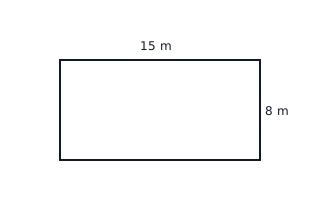
A rectangular garden has a length of and a width of . Find the perimeter and the area of the garden.
Solution:
- Perimeter:
- Area:
Explanation:
To find the perimeter, we add the length and width and then double the result. To find the area, we multiply the length by the width.
Problem 4:
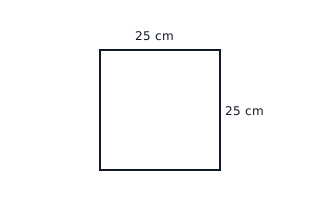
A square tile has a side length of . Calculate its area and perimeter.
Solution:
- Area:
- Perimeter:
Explanation:
Since it is a square, all sides are equal. The area is the side length squared, and the perimeter is four times the side length.