
Review the key concepts, formulae, and examples before starting your quiz.
🔑Concepts
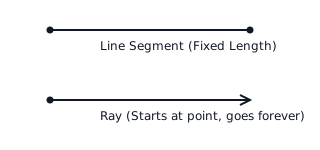
A line segment is a part of a line with two endpoints. A ray has one endpoint and continues forever in one direction. A line continues forever in both directions.
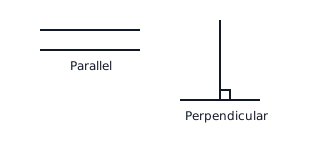
Parallel lines are always the same distance apart and will never meet, like train tracks. Perpendicular lines meet at a right angle (), like the corner of a book.
An angle is formed when two rays or lines meet at a common point called the vertex. We measure the 'openness' of this turn in degrees ().
Types of angles: Acute angles are small (less than ), Right angles are square (), and Obtuse angles are wide (between and ).
📐Formulae
💡Examples
Problem 1:
Look at the capital letter . How many right angles can you find inside this shape, and how would you describe the lines that form them?
Solution:
In a standard capital , there are internal corners where the horizontal bars meet the vertical spine. Each of these corners forms a of . The horizontal lines and the vertical line are to each other.
Explanation:
We identify right angles by looking for perfect square corners. Since the horizontal strokes of the meet the vertical stroke at , they are perpendicular.
Problem 2:
An angle measures . Is this angle acute, right, or obtuse? Explain why.
Solution:
The angle is . Since , it is smaller than a right angle.
Explanation:
We compare the given measurement to the benchmark of a right angle (). Any angle less than is categorized as acute.
Problem 3:
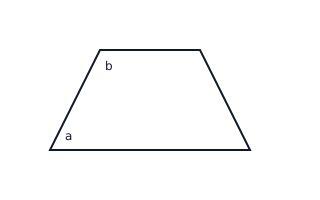
Identify the types of angles labeled and in the shape shown below.
Solution:
Angle is an acute angle. Angle is an obtuse angle.
Explanation:
By looking at the shape, angle is smaller than a square corner (), making it acute. Angle is wider than a square corner ( but ), making it obtuse.
Problem 4:
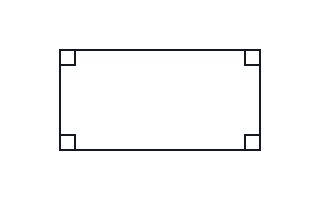
Count the number of pairs of parallel lines and the number of right angles in the rectangle shown.
Solution:
There are pairs of parallel lines and right angles.
Explanation:
A rectangle has opposite sides that are parallel (top/bottom and left/right), totaling pairs. Every corner of a rectangle is a perfect square corner, which means there are right angles of .