
Review the key concepts, formulae, and examples before starting your quiz.
🔑Concepts
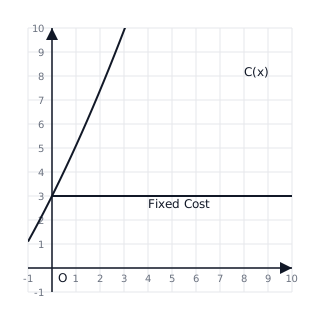
Total Cost Function () consists of a Fixed Cost (), which is constant regardless of production level, and a Variable Cost (), which changes with the number of units () produced. The graph typically starts at the value of on the y-axis.
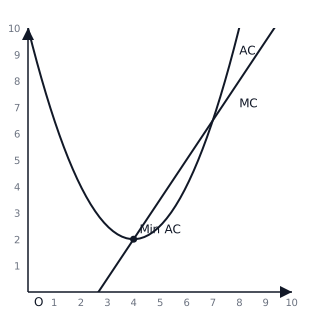
The Average Cost () is the cost per unit, calculated as . Geometrically, the value of that minimizes occurs at the point where the Marginal Cost () curve intersects the curve from below.
Marginal Revenue () is the rate of change of Total Revenue () with respect to the quantity sold (). It represents the additional revenue generated by selling one more unit.
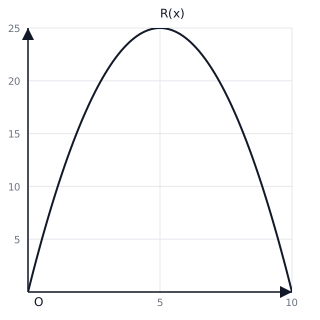
Profit Maximization occurs when the difference between and is at its greatest positive value. This happens when and the second derivative of the profit function is negative ().

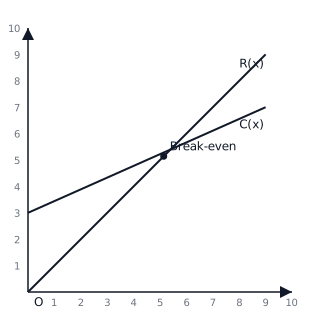
Break-even point is the level of production where Total Revenue equals Total Cost (), resulting in zero profit. At this point, the business covers all its expenses but does not yet earn a surplus.
📐Formulae
Total Cost:
Average Cost:
Marginal Cost:
Total Revenue: (where is the demand function)
Marginal Revenue:
Profit Function:
Average Profit:
Marginal Profit:
Condition for Profit Maximization: and
💡Examples
Problem 1:
The cost function for a manufacturer is given by . Find the Marginal Cost and Average Cost when .
Solution:
Step 1: Find Marginal Cost (). At , .
Step 2: Find Average Cost (). At , .
Explanation:
We use the derivative of the cost function to find the marginal cost and the ratio of total cost to units to find the average cost.
Problem 2:
A company sells items at a price of each. The cost of producing items is . Determine the value of that maximizes the profit.
Solution:
Step 1: Find the Revenue function .
Step 2: Find the Profit function .
Step 3: Find the derivative and set it to zero for critical points. Set
Step 4: Check the second derivative for maximization. Since , the profit is maximized at .
Explanation:
To maximize profit, we first construct the profit function from revenue and cost, then find the level of output where the first derivative is zero and ensure the second derivative is negative.
Problem 3:
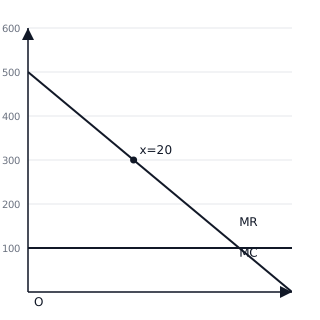
A manufacturer's demand function is and the cost function is . Calculate the Marginal Revenue () and Marginal Cost () when units. Also, determine if the profit is increasing or decreasing at this level of output.
Solution:
- Find Revenue:
- Find : . At ,
- Find :
- Find Marginal Profit: Since at , the profit is increasing.
Explanation:
We differentiate the Revenue and Cost functions to find the marginal values. Because the Marginal Revenue is higher than the Marginal Cost, each additional unit produced adds more to income than to expense, thus increasing total profit.
Problem 4:
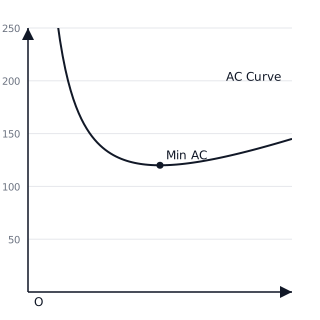
The total cost of producing units is . Find the level of output at which the Average Cost () is minimized.
Solution:
- Find Average Cost:
- Differentiate with respect to :
- Set derivative to zero for minimum:
- Verify using second derivative: , which is positive for , so is minimized.
Explanation:
To find the minimum average cost, we first derive the function by dividing the total cost by the number of units. We then find the stationary point by setting the derivative to zero. The second derivative test confirms it is a minimum.