
Review the key concepts, formulae, and examples before starting your quiz.
🔑Concepts
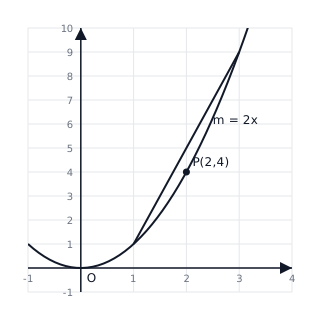
The power rule describes how the slope of a polynomial function changes. Geometrically, the derivative represents the gradient of the tangent line at any point on the curve.
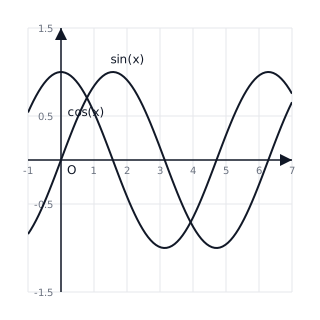
The derivative of trigonometric functions like and are periodic. For example, . This means the rate of change of the sine wave is exactly the value of the cosine wave at that same point.
The Product Rule is used when two functions are multiplied together. Think of it as the sum of one function times the rate of change of the other.

The Quotient Rule is applied to algebraic fractions. The order in the numerator is critical: start with the denominator function times the derivative of the numerator.
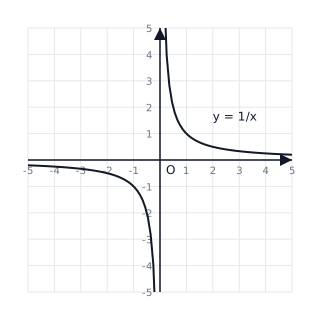
The Chain Rule allows us to differentiate composite functions. It is often visualized as 'differentiating the outer layer and multiplying by the derivative of the inner layer'.

📐Formulae
💡Examples
Problem 1:
Differentiate with respect to .
Solution:
Explanation:
Apply the power rule to to get . Use the rule for the second term, and the rule that differentiates to itself for the third term.
Problem 2:
Find the derivative of .
Solution:
Explanation:
Use the Product Rule where and . Then and . The result is .
Problem 3:
Differentiate using the Chain Rule.
Solution:
Explanation:
Let the inner function be . Then . Differentiate the outer function and multiply by the derivative of the inner function .
Problem 4:
Find the gradient of the tangent to at .
Solution:
At :
Explanation:
Apply the Quotient Rule where and . Then substitute into the resulting derivative function. Note that and .
Problem 5:
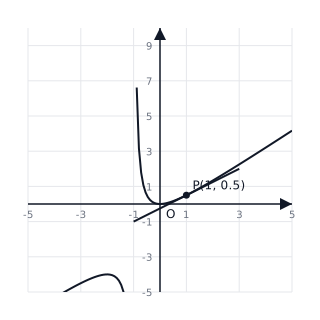
Find the derivative of the function and determine the value of .
Solution:
Let and . Then and . Using the Quotient Rule: Substitute :
Explanation:
We identify the function as a quotient of two simpler functions. Applying the quotient rule formula and simplifying the numerator allows us to find the gradient function, which we then evaluate at the given point.
Problem 6:
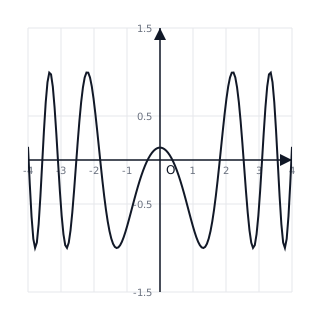
Differentiate the composite function .
Solution:
This is a composite function of the form where . Find the derivatives: Using the Chain Rule:
Explanation:
We use the Chain Rule to handle the 'function of a function'. First, we differentiate the outer sine function (which becomes cosine) and then multiply by the derivative of the inner polynomial expression.