
Review the key concepts, formulae, and examples before starting your quiz.
🔑Concepts
Pascal's Triangle is a triangular array of numbers where each number is the sum of the two numbers directly above it. It provides the binomial coefficients for the expansion of .
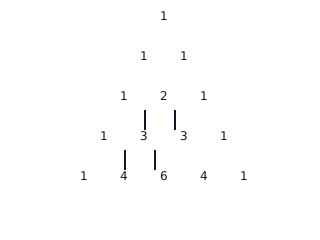
The row of Pascal's Triangle (starting with ) corresponds to the coefficients of . For example, the row corresponds to .
Each row starts and ends with . This corresponds to the identity for any non-negative integer .
Pascal's Identity, , is the mathematical rule that generates the triangle: adding two adjacent entries in one row gives the entry below them in the next row.
The triangle is symmetrical about a vertical line passing through its apex. This reflects the property .
The sum of the entries in the row is always equal to . For the row (), the sum is .
📐Formulae
(General Term formula)
(Pascal's Identity)
💡Examples
Problem 1:
Expand using the coefficients from Pascal's Triangle.
Solution:
Step 1: Identify the row in Pascal's Triangle for . The coefficients are . Step 2: Write the expansion using these coefficients and decreasing powers of and increasing powers of . Step 3: Simplify each term.
Explanation:
This approach uses the 4th row of Pascal's Triangle to quickly identify the binomial coefficients, then applies the rule of decreasing/increasing exponents to the variables and .
Problem 2:
Find the 3rd term in the expansion of .
Solution:
Step 1: Identify the components for the general term formula . Here, , , , and for the 3rd term, . Step 2: Substitute the values into the formula. Step 3: Calculate . Step 4: Simplify the expression.
Explanation:
To find a specific term without expanding the whole binomial, we use the General Term formula. Note that the sign of the second term must be included in the calculation.
Problem 3:
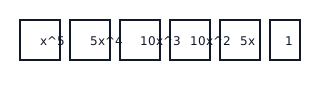
Using Pascal's Triangle, expand .
Solution:
- Identify the row in Pascal's triangle for . The coefficients are .
- Apply the binomial expansion formula:
- Simplify the expression:
Explanation:
Each term follows the pattern . Since , its powers remain 1, leaving only the powers of and the coefficients.
Problem 4:
Evaluate using binomial expansion and Pascal's Triangle.

Solution:
- Express as . We need .
- For , Pascal's Triangle coefficients are .
- Use the expansion:
- Calculate individual values:
- Sum the values: So, .
Explanation:
Splitting a number into a sum of a multiple of 10 and a small integer simplifies the powers significantly.