
Review the key concepts, formulae, and examples before starting your quiz.
🔑Concepts
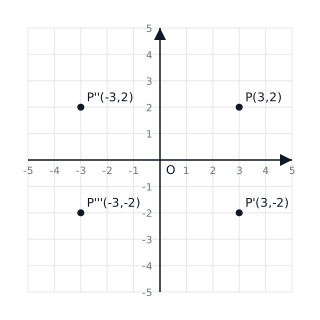
Reflection across axes and the origin transforms a point by changing the signs of its coordinates. Reflection in the -axis produces , reflection in the -axis produces , and reflection in the origin produces . Points lying on the line of reflection are called invariant points as their coordinates remain unchanged.
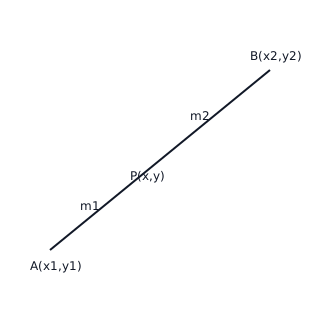
The Section Formula determines the coordinates of a point that divides a line segment joining and in a given ratio . If lies between and , it is internal division.
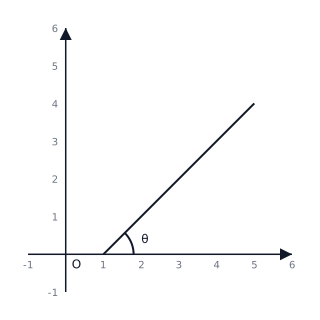
The slope of a line, , represents its inclination. It is calculated as the tangent of the angle that the line makes with the positive -axis () or using two points on the line: . Parallel lines have equal slopes (), while perpendicular lines have slopes whose product is ().
The equation of a line can be expressed in different forms depending on the available data: Slope-Intercept form () where is the -intercept, or Point-Slope form () when a specific point on the line and its slope are known.
📐Formulae
Reflection in -axis:
Reflection in -axis:
Reflection in Origin:
Distance Formula:
Section Formula:
Midpoint Formula:
Centroid Formula:
Slope ():
Slope-Intercept Form:
Point-Slope Form:
💡Examples
Problem 1:
Point is reflected in the -axis to . Point is the reflection of in the origin. Find the coordinates of and . Also, find the equation of the line .
Solution:
- Reflection of in the -axis: changes sign .
- Reflection of in the origin: both and change signs .
- To find the equation of line , first find the slope using and : .
- Since the slope is , the line is horizontal. Using : .
Explanation:
We first applied reflection rules for the -axis and the origin. Since the -coordinates of and are the same, the line is horizontal, resulting in a slope of and an equation of the form .
Problem 2:
Find the ratio in which the line segment joining and is divided by the point . Also, find the value of .
Solution:
- Let the ratio be . Using the -coordinate of the section formula: .
- Multiply by : .
- Solve for : . So the ratio is .
- Now find using the ratio : .
Explanation:
By assuming the ratio , we use the known -coordinate of the division point to solve for . Once the ratio is established, the -coordinate is found by substituting the ratio back into the section formula.
Problem 3:
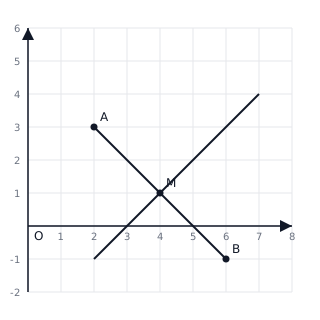
Find the equation of the perpendicular bisector of the line segment joining and .
Solution:
- Find the midpoint of : .
- Find the slope of (): .
- Slope of the perpendicular bisector (): Since , .
- Use point-slope form with and : .
Explanation:
A perpendicular bisector passes through the midpoint of a segment at a angle. We calculate the midpoint to find a point on the line and use the negative reciprocal of the segment's slope to find the bisector's slope.
Problem 4:
The point is reflected in the -axis to . is then reflected in the line to . Find the coordinates of and .
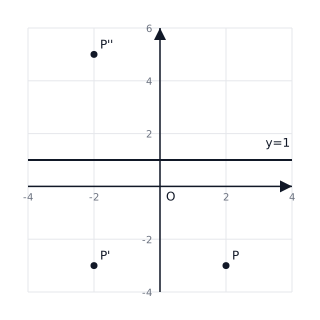
Solution:
- Reflection of in the -axis: . Thus, .
- Reflection of in the line : The -coordinate remains . The distance of from is units. The image will be units above the line . So, . Thus, .
Explanation:
Reflecting in the y-axis flips the sign of the x-coordinate. Reflecting across a horizontal line keeps the x-coordinate the same and moves the y-coordinate such that the line is the midpoint between the original and reflected y-values.