
Review the key concepts, formulae, and examples before starting your quiz.
🔑Concepts
The Surface Area of a combination of solids is the sum of the visible surface areas of the individual components. When two solids are joined, the surface areas that are in contact (the overlapping faces) are subtracted from the total sum of their individual surface areas.
The Volume of a combination of solids is simply the sum of the volumes of the constituent solids, as volume represents the space occupied. Unlike surface area, no subtraction is needed for internal contact surfaces.
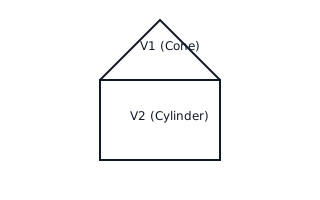
Slant Height () of a cone: In problems involving cones or frustums, the slant height is crucial for calculating Curved Surface Area (CSA). It is related to height () and radius () by the Pythagorean relation .
Conversion of Solids: When a solid is melted and recast into another shape, the volume remains constant. This principle is used to find unknown dimensions of the new shape.
📐Formulae
patterns
💡Examples
Problem 1:
Two cubes each of volume are joined end to end. Find the surface area of the resulting cuboid.
Solution:
- Find the edge of the cube ():
- When two cubes are joined, the dimensions of the resulting cuboid are: Length () = Breadth () = Height () =
- Surface Area of Cuboid = :
Explanation:
To solve this, we first find the side of the original cubes. When joined, only the length changes (it doubles), while the width and height remain the same. We then apply the standard surface area formula for a cuboid.
Problem 2:
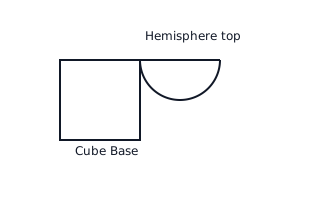
A decorative block is made of two solids — a cube and a hemisphere. The base of the block is a cube with edge , and the hemisphere fixed on the top has a diameter of . Find the total surface area of the block.
Solution:
- Surface area of cube = .
- The hemisphere is attached to one face, covering a circular area.
- TSA of block = (TSA of cube) - (Base area of hemisphere) + (CSA of hemisphere).
- Radius () of hemisphere = .
Explanation:
The total surface area is the sum of the cube's area and the hemisphere's curved area, minus the area of the cube's face that is covered by the hemisphere's base.
Problem 3:
Calculate the total volume of a solid consisting of a cylinder of length and radius topped with a hemisphere of the same radius.
Solution:
- Volume of Cylinder () =
- Volume of Hemisphere () =
- Total Volume ():
Explanation:
The volume of a combined solid is simply the sum of the volumes of its parts. Here, we add the volume of the cylinder to the volume of the hemisphere.
Problem 4:
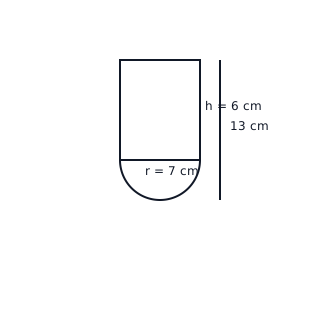
A vessel is in the form of a hollow hemisphere mounted by a hollow cylinder. The diameter of the hemisphere is and the total height of the vessel is . Find the inner surface area of the vessel.
Solution:
Radius of hemisphere () = Radius of cylinder () = Height of cylinder () = Inner surface area = Inner surface area = Inner surface area = Inner surface area =
Explanation:
To find the surface area of the combined shape, we sum the curved surface areas of the cylinder and the hemisphere. Note that the circular base of the cylinder and top of the hemisphere are not part of the surface area as they are internal.
Problem 5:
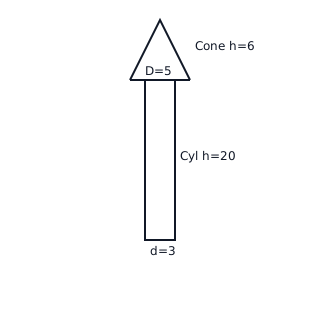
A wooden toy rocket is in the shape of a cone mounted on a cylinder. The height of the entire rocket is , while the height of the conical part is . The base of the conical portion has a diameter of , while the base diameter of the cylindrical portion is . Find the volume of the rocket.
Solution:
Height of cone () = , Radius of cone () = Height of cylinder () = , Radius of cylinder () =
Explanation:
The total volume is the sum of the volumes of the two distinct 3D shapes. We identify the specific height and radius for the cone and the cylinder separately.