
Review the key concepts, formulae, and examples before starting your quiz.
🔑Concepts
The zero of a polynomial is the -coordinate of the point where the graph of intersects or touches the -axis. For a linear polynomial , the graph is a straight line and has exactly one zero.
For a quadratic polynomial , the graph is a parabola. It can intersect the -axis at two distinct points, touch it at one point, or not intersect it at all, corresponding to having 2, 1, or 0 real zeroes respectively.
To verify a zero algebraically, substitute into the polynomial. If , then is confirmed as a zero of the polynomial.
The number of zeroes of a polynomial of degree is at most . This means the graph of can intersect the -axis at most at points.
📐Formulae
(Condition for to be a zero)
(Zero of a linear polynomial )
(General form of a quadratic polynomial)
(For a polynomial of degree )
💡Examples
Problem 1:
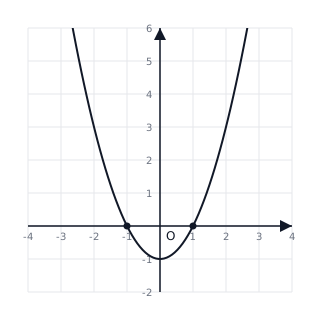
Look at a graph of that crosses the x-axis at and , and crosses the y-axis at . Determine the number of zeroes and specify what they are.
Solution:
- Identify the points where the graph intersects the x-axis: and .
- The zeroes are the x-coordinates of these intersection points: and .
- Ignore the y-intercept as it does not indicate a zero.
- Total number of zeroes = .
Explanation:
The geometric meaning of a zero is the x-coordinate of the point where the graph meets the x-axis. Since there are two such points, the polynomial has two zeroes.
Problem 2:
Given the quadratic polynomial , describe the nature of its graph and identify the number of zeroes based on its algebraic form .
Solution:
- The polynomial can be rewritten as .
- To find the zeroes, set , which gives .
- Since there is only one unique value, the graph (a parabola opening upwards because ) touches the x-axis at exactly one point: .
- Number of zeroes = (or two coincident zeroes).
Explanation:
When a quadratic is a perfect square, its parabola just touches the x-axis at a single point, representing one unique real zero.
Problem 3:
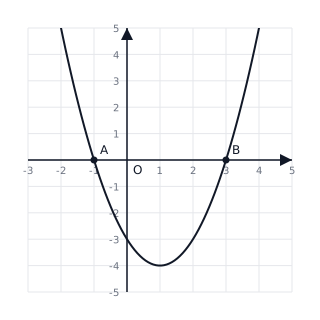
Identify the zeroes of the polynomial from its graph and verify them algebraically.
Solution:
- Graphical Observation: From the graph, the parabola intersects the -axis at and . Therefore, the zeroes are and .
- Algebraic Verification: Substitute : . Substitute : . Both values are verified as zeroes.
Explanation:
The points and are the x-intercepts. Since at these values, they are the zeroes.
Problem 4:
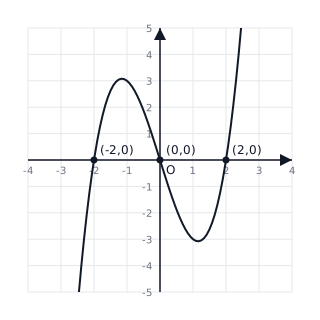
Identify the zeroes of the cubic polynomial from its graph and verify your findings algebraically.
Solution:
-
Graphical Observation: From the graph, we observe that the curve intersects the -axis at three distinct points: , , and . Therefore, the zeroes of the polynomial are , , and .
-
Algebraic Verification: To find the zeroes of , set : Factor out the common term : Factor the difference of squares as : Setting each factor to zero gives: The algebraic zeroes are , which matches the graphical observation.
Explanation:
The zeroes of a polynomial are the -coordinates of the points where the graph of intersects the -axis. For the cubic polynomial , the graph crosses the axis at three points, indicating three real zeroes. Factorization confirms these specific values.