
Review the key concepts, formulae, and examples before starting your quiz.
🔑Concepts
Fuel cells are electrochemical cells that convert the chemical energy of a fuel, such as hydrogen or methane, directly into electrical energy. Unlike conventional cells, the reactants are continuously supplied to the electrodes from an external source.
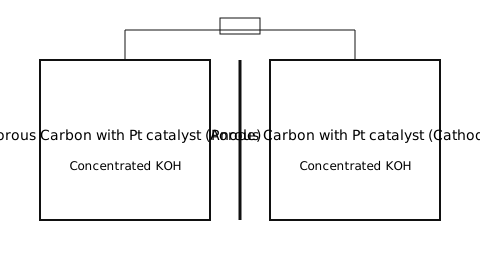
In a fuel cell, the anode reaction involves the oxidation of hydrogen:
The cathode reaction in a fuel cell involves the reduction of oxygen: resulting in the overall cell reaction: with a theoretical cell potential of .
Fuel cells are preferred over thermal power plants because they are highly efficient (theoretical efficiency up to ) and pollution-free, as the only byproduct is water.
📐Formulae
💡Examples
Problem 1:
Calculate the thermodynamic efficiency of a fuel cell if the standard free energy of formation of liquid water is and the standard enthalpy of formation is .
Solution:
Given: and . Efficiency .
Explanation:
The efficiency of a fuel cell is defined as the ratio of the maximum useful work (Gibbs free energy change) to the total heat released during combustion (Enthalpy change).
Problem 2:
For the reaction , what is the value of (number of moles of electrons) used in the formula?
Solution:
In the oxidation half-reaction: . Therefore, for the balanced overall reaction as written, .
Explanation:
Each hydrogen molecule loses electrons to form . Since the balanced equation uses moles of , a total of moles of electrons are transferred.
Problem 3:
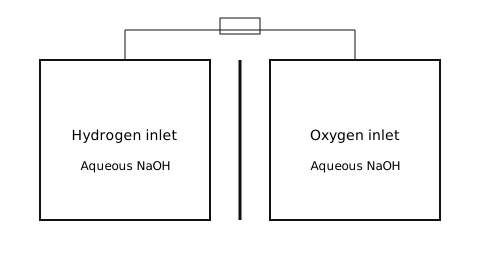
Identify the species being oxidized and reduced in the fuel cell shown, and calculate the total number of electrons () transferred for the production of one mole of liquid water.
Solution:
The half-cell reactions are: Anode: (Oxidation) Cathode: (Reduction) For the formation of mole of , the net reaction is . Summing the electrons transferred in this stoichiometric ratio, we find .
Explanation:
Hydrogen gas loses electrons at the anode (oxidation state changes from to ), while Oxygen gas gains electrons at the cathode (oxidation state changes from to ).
Problem 4:
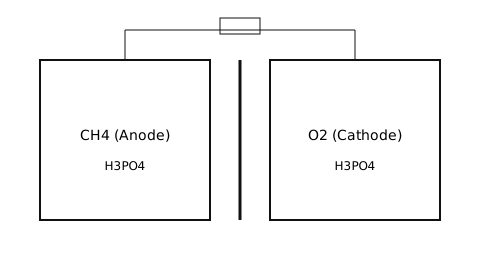
A fuel cell operates using the reaction . If the cell is set up with methane at the left electrode and oxygen at the right electrode in an acidic electrolyte, identify the anode reaction.
Solution:
In an acidic medium, methane is oxidized at the anode as follows:
Explanation:
The fuel (methane) is always fed to the anode where oxidation occurs. Since the carbon in is in the oxidation state and in it is , a total of electrons are released per molecule of methane.