
Review the key concepts, formulae, and examples before starting your quiz.
🔑Concepts
An electrochemical cell converts chemical energy into electrical energy through spontaneous redox reactions. In a standard Daniel cell, the Zinc electrode acts as the anode (oxidation) and the Copper electrode acts as the cathode (reduction).
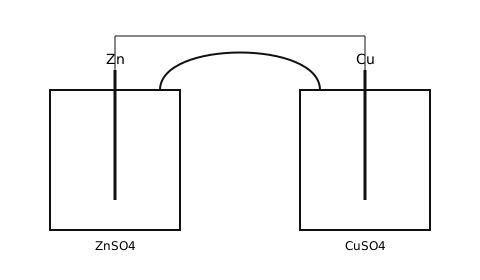
The salt bridge is a U-shaped tube containing an inert electrolyte like or in agar-agar. It maintains electrical neutrality in both half-cells by allowing the migration of ions and completes the internal circuit.
Electrode Potential () is the potential difference between the electrode and its electrolyte. When concentrations are , gas pressure is , and temperature is , it is called Standard Electrode Potential ().
Cell notation follows the convention: Anode | Anodic Electrolyte || Cathodic Electrolyte | Cathode. For example: .
The Nernst Equation relates the cell potential to the concentration of ions: at .
📐Formulae
💡Examples
Problem 1:
Calculate the for the following cell at : . Given and .
Solution:
- Find : .
- Identify : The reaction is , so .
- Apply Nernst Equation: .
- Substitute values: .
Explanation:
We first determine the standard cell potential using reduction potentials. Then, the Nernst equation is used to adjust for non-standard concentrations. Since the concentration of is 10 times that of , the log term reduces the overall potential.
Problem 2:
Calculate the standard Gibbs energy change () for the reaction: , given .
Solution:
- Identify : The reaction involves the transfer of electrons (), so .
- Use the formula: .
- Substitute values: .
- Calculate: .
Explanation:
Standard Gibbs energy change is directly proportional to the standard cell potential. The negative value indicates that the reaction is thermodynamically spontaneous under standard conditions.
Problem 3:
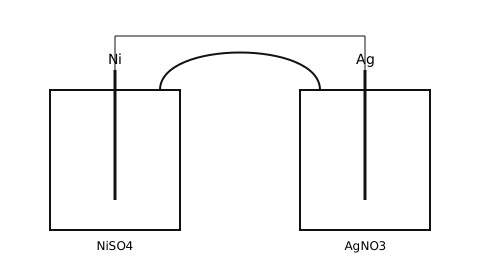
Calculate the equilibrium constant () for the reaction occurring in a cell consisting of Silver and Nickel electrodes at . The cell is represented as: . Given and .
Solution:
- Calculate :
- Determine (number of electrons): and , so .
- Use the relation:
Explanation:
The equilibrium constant is calculated from the standard cell potential. A large value indicates that the reaction goes nearly to completion.
Problem 4:
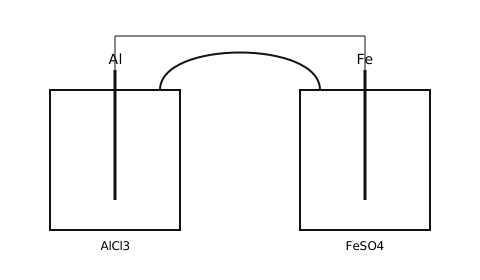
For the cell , calculate the cell potential () at . Given and .
Solution:
- Calculate :
- Write the balanced equation: . Here, .
- Apply Nernst Equation:
Explanation:
The Nernst equation accounts for the non-standard concentrations of the aluminum and iron ions to find the actual electromotive force of the cell.