
Review the key concepts, formulae, and examples before starting your quiz.
🔑Concepts
The Dry Cell (Leclanché Cell) is a primary cell where the chemical energy is converted into electrical energy via irreversible reactions. The container itself acts as the anode ( container), while a carbon rod (graphite) surrounded by powdered and carbon serves as the cathode.
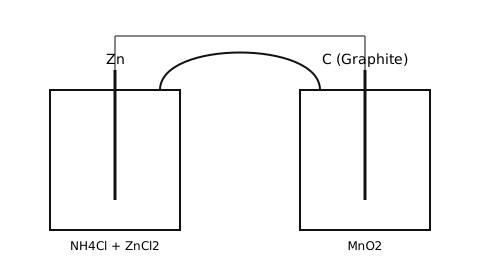
In a dry cell, the electrolyte is not a liquid but a moist paste of and . The zinc anode undergoes oxidation: . The ammonia gas produced at the cathode reacts with to form the complex ion , preventing pressure buildup.
The Lead Accumulator is a secondary cell (rechargeable). During discharge, it acts as a galvanic cell where lead () is the anode and lead dioxide () is the cathode, both immersed in approximately .
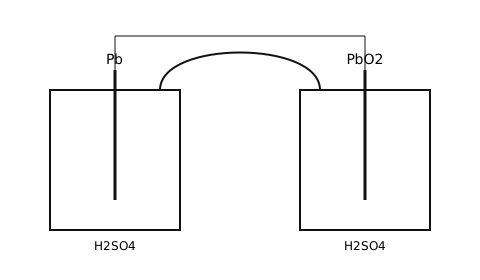
Recharging the lead accumulator involves reversing the electrochemical process by applying an external voltage. During charging, deposited on the electrodes is converted back to and , and the density of increases as water is consumed and acid is regenerated.
📐Formulae
💡Examples
Problem 1:
Write the overall cell reaction for a lead storage battery during the discharging process and state what happens to the density of the electrolyte.
Solution:
The overall reaction is: . The density of the electrolyte decreases.
Explanation:
During discharging, is consumed to form water and solid . Since is denser than water, its consumption and the production of lead to a decrease in the overall density/specific gravity of the electrolyte.
Problem 2:
Why is the dry cell not truly 'dry'?
Solution:
It contains a moist paste of and .
Explanation:
For ions to move and conduct electricity between the electrodes, a liquid or moisture-rich medium is necessary. If the cell were completely dry, the internal resistance would be infinite, and no current would flow.
Problem 3:
Calculate the amount of produced if Faradays of electricity is drawn from a lead accumulator.
Solution:
are produced at each electrode, totaling for the whole cell.
Explanation:
From the half-reactions, mole of produces mole of by releasing . Thus, of charge produces mole of at the anode and mole at the cathode. Therefore, will produce moles at each electrode based on the stoichiometry of the -electron process.
Problem 4:
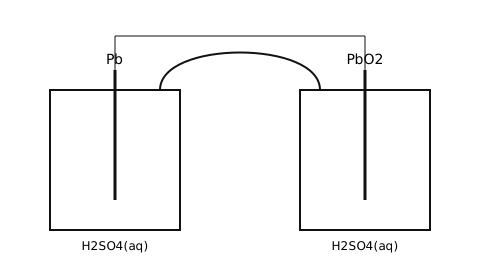
During the discharging of a lead storage battery, the density of the electrolyte falls from to . If the total volume of the electrolyte is , and the initial percentage of by mass is , explain the chemical change at the anode and visualize the cell setup.
Solution:
During discharge, the anode reaction is: The density decreases because is consumed to form and water () is produced as a byproduct in the overall reaction: This dilution of the acid results in the drop in density.
Explanation:
The lead anode releases electrons and reacts with sulfate ions from the acid to form solid lead sulfate, which adheres to the plate.
Problem 5:
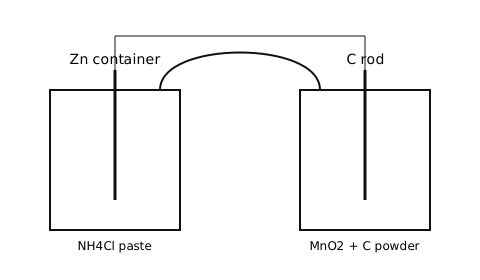
Identify the components and the direction of electron flow in a standard Leclanché dry cell during operation.
Solution:
In a dry cell, electrons flow from the Zinc cup (anode) through the external circuit to the Carbon rod (cathode). The Zinc undergoes oxidation: and these electrons are consumed at the cathode by and .
Explanation:
The zinc container serves as the negative terminal (source of electrons), while the graphite rod serves as the positive terminal where reduction occurs.