
Physics - Electricity and Magnetism (Static Electricity, Current, Simple Circuits, Magnetic Field)
Review the key concepts, formulae, and examples before starting your quiz.
🔑Concepts
Static Electricity: It is the study of electric charges at rest. According to the law of electrostatics, like charges repel each other, while unlike charges attract each other.

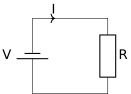
Electric Current: The rate of flow of charge through a cross-section of a conductor. By convention, the direction of current is taken from the positive terminal to the negative terminal of the cell.
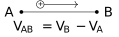
Potential Difference: The work done in moving a unit positive charge from one point to another in an electric field. It is measured in Volts ().
Magnetic Field Lines: Imaginary lines around a magnet along which a North pole would move. They emerge from the North pole and enter the South pole externally.

📐Formulae
💡Examples
Problem 1:
Calculate the current flowing through a wire if a charge of flows through it in minutes.
Solution:
Given: , . Using the formula , we get .
Explanation:
To find the current, the time must be converted into the SI unit (seconds) before dividing the total charge by the time duration.
Problem 2:
How much work is done in moving a charge of across two points having a potential difference of ?
Solution:
Given: , . Using the formula , we rearrange to find . Thus, .
Explanation:
Work done is the product of the potential difference and the magnitude of the charge moved.
Problem 3:
A conductor has a resistance of . If a potential difference of is applied across its ends, calculate the current.
Solution:
Given: , . From Ohm's Law, . So, .
Explanation:
Current is directly proportional to potential difference and inversely proportional to resistance as per .
Problem 4:
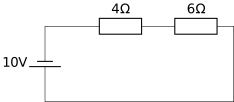
Determine the equivalent resistance of the circuit shown below where two resistors and are connected in series to a battery.
Solution:
In a series circuit, the total resistance is the sum of individual resistances: The total current is:
Explanation:
Since the resistors are connected end-to-end, the same current flows through both, and their resistances add up directly.
Problem 5:
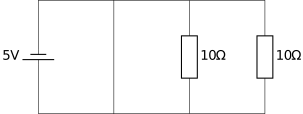
Calculate the total current flowing from the battery in the following parallel circuit where and are connected to a source.
Solution:
For resistors in parallel, the equivalent resistance is: Total current :
Explanation:
In a parallel circuit, the potential difference across each resistor is the same, but the total current is the sum of currents through each branch.