
Review the key concepts, formulae, and examples before starting your quiz.
🔑Concepts
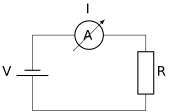
Current is the rate of flow of electric charge, measured in Amperes (). In a circuit, an ammeter must be connected in series to measure the current flowing through a component.
Potential Difference (Voltage) is the work done per unit charge moving between two points. A voltmeter must be connected in parallel across a component to measure the potential difference.
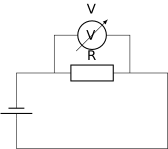
Resistance is the opposition to the flow of current, measured in Ohms (). According to Ohm's Law, for a conductor at constant temperature, the current is directly proportional to the potential difference across it.

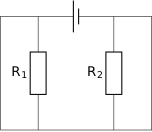
In a parallel circuit, the total current from the source is the sum of the currents through the individual branches, while the potential difference across each branch remains the same.
📐Formulae
💡Examples
Problem 1:
A charge of passes through a light bulb in . Calculate the current flowing through the bulb.
Solution:
Explanation:
To find current, divide the total charge by the time in seconds. The unit is Amperes ().
Problem 2:
Calculate the resistance of a component if a potential difference of causes a current of to flow through it.
Solution:
Explanation:
Using Ohm's Law (), we rearrange the formula to to find the resistance in Ohms.
Problem 3:
Two resistors, and , are connected in series to a power supply. Calculate the total resistance and the current in the circuit.
Solution:
;
Explanation:
In a series circuit, total resistance is the sum of individual resistances. Then, Ohm's Law is used to find the total current.
Problem 4:
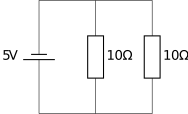
Find the total current flowing from the battery in a circuit where two resistors, and , are connected in parallel to a supply.
Solution:
- Calculate the total resistance () for the parallel branches:
- Use Ohm's Law to find the total current ():
Explanation:
In a parallel circuit, the reciprocal of the total resistance is the sum of the reciprocals of individual resistances. Once the equivalent resistance is found, the total current can be calculated using the supply voltage.
Problem 5:
A circuit consists of a battery and three resistors in series: , , and . Determine the potential difference across the resistor.
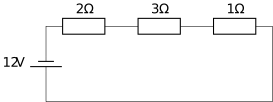
Solution:
- Calculate total resistance ():
- Calculate the circuit current ():
- Calculate the potential difference across ():
Explanation:
The current is the same at all points in a series circuit. By finding the total resistance, we find the common current, which is then used to find the specific voltage drop across one resistor.