
Review the key concepts, formulae, and examples before starting your quiz.
🔑Concepts
Static Electricity: It is the study of electric charges at rest. Charging by friction involves the transfer of electrons from one body to another, resulting in one becoming positively charged and the other negatively charged.
Electric Current (): The rate of flow of charge through a cross-section of a conductor. It is measured in Amperes (). Conventionally, current flows from the positive terminal to the negative terminal of a cell.
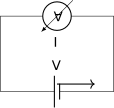
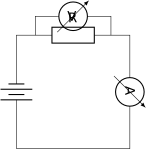
Ohm's Law: At a constant temperature, the current () flowing through a conductor is directly proportional to the potential difference () across its ends, expressed as .
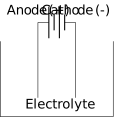
Chemical Effects: When electric current passes through a conducting solution (electrolyte), chemical reactions occur. This process is called electrolysis, which is used in electroplating.
📐Formulae
💡Examples
Problem 1:
Calculate the current flowing through a conductor if a charge of passes through it in minutes.
Solution:
Given: Charge , Time . Using the formula , we get .
Explanation:
To find the current, the time must be converted from minutes to the SI unit of seconds before applying the formula .
Problem 2:
Two resistors of and are connected in parallel. Calculate their equivalent resistance.
Solution:
Given: and . In parallel: . Therefore, .
Explanation:
In a parallel circuit, the reciprocal of the total resistance is the sum of the reciprocals of individual resistances. The effective resistance is always less than the smallest individual resistance.
Problem 3:
An electric heater of resistance draws a current of . Calculate the heat produced in seconds.
Solution:
Given: , , . Using Joule's Law: .
Explanation:
The heat produced is directly proportional to the square of the current, the resistance, and the time for which the current flows.
Problem 4:
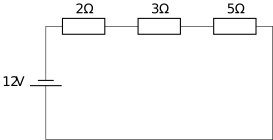
Determine the total resistance and the current flowing through a circuit where a battery is connected to three resistors of , , and connected in series.
Solution:
Total resistance Using Ohm's Law: The current flowing through the circuit is .
Explanation:
In a series circuit, the total resistance is the sum of individual resistances. Since the same current flows through all components in series, we divide the total voltage by the equivalent resistance to find the current.
Problem 5:
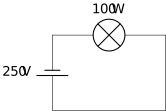
An electric bulb is rated . Calculate the resistance of its filament and the current it draws when connected to a supply.
Solution:
Given: , We know , so Now, using , The resistance is and current is .
Explanation:
The power rating allows us to find the current using the power formula. Once the current and voltage are known, the resistance of the filament can be calculated using Ohm's Law.