
Review the key concepts, formulae, and examples before starting your quiz.
🔑Concepts
Distance-time graphs represent how the position of an object changes over time. Time is plotted on the -axis and distance on the -axis. A straight line starting from the origin passing through the points indicates uniform motion, where the speed is constant.
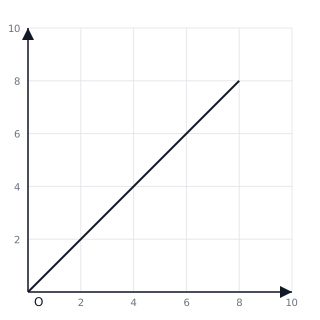
The steepness or slope of the distance-time graph represents the speed of the object. A steeper line indicates a higher speed because more distance is covered in the same amount of time.
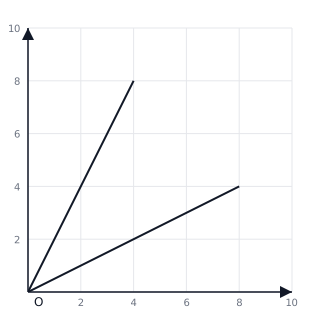
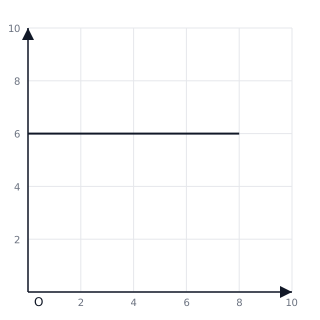
If the distance-time graph is a horizontal line parallel to the -axis, it indicates that the distance does not change as time passes. This means the object is at rest (stationary) and its speed is .
Curved lines on a distance-time graph indicate non-uniform motion. If the curve bends upwards, the speed of the object is increasing (acceleration). If the curve flattens out, the speed is decreasing (deceleration).
📐Formulae
💡Examples
Problem 1:
From a distance-time graph, a cyclist is seen to cover a distance of in at a constant speed. Calculate the speed and describe the shape of the graph.
Solution:
Given: , . Using the formula , we get .
Explanation:
Since the speed is constant at , the distance-time graph will be a straight line starting from the origin and passing through the point .
Problem 2:
A car's position on a graph stays at for the time interval between and . What is the speed of the car during this interval?
Solution:
.
Explanation:
Because the distance does not change as time passes, the graph is a horizontal line. This indicates the car is stationary (at rest).
Problem 3:
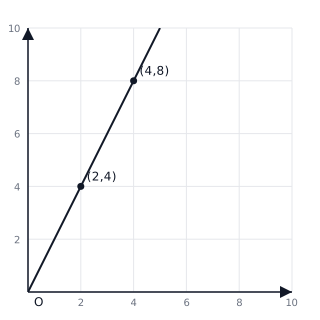
Observe the provided distance-time graph for a toy car. Using the data points and , where time is in seconds and distance is in meters, calculate the speed of the car.
Solution:
Explanation:
The speed is determined by finding the slope of the line. By taking two points on the line, we calculate the change in distance over the change in time.
Problem 4:
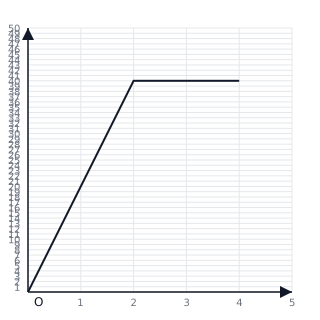
A bus moves from Point A to Point B in hours and remains there for hours before returning. The graph shows the first hours of this journey. What is the distance of the bus from the starting point at ?
Solution:
Explanation:
Between and , the graph is a horizontal line. This signifies the bus is stationary at Point B, which is away from the start. Therefore, at , its distance remains .