
Review the key concepts, formulae, and examples before starting your quiz.
🔑Concepts
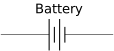
The Electric Cell and Battery: An electric cell provides energy to the circuit. It has a positive (+) terminal (long thin line) and a negative (-) terminal (short thick line). A battery is a combination of two or more cells connected in series where the positive terminal of one cell is connected to the negative terminal of the next.
The Switch (Key): A switch is a control device that can 'make' or 'break' the circuit. When the switch is in the 'ON' position, the circuit is closed, and current flows. When it is in the 'OFF' position, the circuit is open, and current stops.
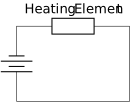
Heating Effect of Current: When an electric current flows through a wire, the wire gets hot due to resistance. This is used in appliances like electric heaters and irons. The amount of heat depends on the current , the resistance of the wire, and the time for which the current flows.
Magnetic Effect of Current: Hans Christian Oersted discovered that when current flows through a wire, it behaves like a magnet. This effect is used to create electromagnets, where a wire is coiled around a soft iron core.
Electric Fuse: A fuse is a safety device that prevents damage to electrical circuits and possible fires. It contains a wire that melts quickly and breaks the circuit if the current exceeds a safe limit.

📐Formulae
💡Examples
Problem 1:
Calculate the change in heat produced in a circuit if the electric current passing through it is doubled, keeping resistance and time constant.
Solution:
The heat produced becomes four times the original heat ().
Explanation:
According to Joule's law of heating, . If the current is doubled (), the new heat will be .
Problem 2:
In a battery of four cells, how are the terminals connected?
Solution:
Explanation:
To form a battery, the positive terminal of one cell must be connected to the negative terminal of the adjacent cell to allow the flow of electrons through the circuit.
Problem 3:
An electromagnet has turns and a current of . If the number of turns is increased to , how does the magnetic strength change?
Solution:
The magnetic strength increases by times.
Explanation:
The magnetic field strength of an electromagnet is directly proportional to the number of turns (). Since increased from to (a factor of ), the strength also increases three-fold.
Problem 4:
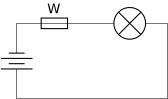
In the following circuit, if the wire is made of a material that melts at low temperatures, what happens to the circuit when the current becomes very high?
Solution:
Explanation:
The component acts as a fuse. When current exceeds the safety limit, the heating effect of the current () causes the temperature to rise. Because has a low melting point, it melts and creates an 'open circuit', stopping the flow of electricity to protect other components.
Problem 5:
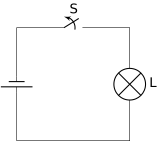
Identify the components shown in the given circuit diagram and determine the state of the circuit (Open or Closed). If the component labeled 'S' is changed to the 'on' position, what will happen to the component 'L'?
Solution:
- Components: Battery (two cells), Switch (S), and Lamp (L).
- Current State: The switch is in the 'open' position, so the circuit is 'Open'.
- Action: When switch 'S' is closed, the circuit becomes complete, and electric current flows from the positive terminal of the battery to the negative terminal. As a result, the lamp 'L' will glow.
Explanation:
In an electric circuit, the switch acts as a control device. When the switch is 'off' (open), there is a gap in the conducting path, preventing the flow of electrons. When the switch is 'on' (closed), the path is continuous, allowing the heating effect of the current to make the filament of the lamp glow.