
Review the key concepts, formulae, and examples before starting your quiz.
🔑Concepts
An electric cell is a source of electricity that converts chemical energy into electrical energy. It has two terminals: a positive terminal () represented by a metal cap and a negative terminal () represented by a flat metal disc.

An electric bulb consists of a thin wire called a 'filament' that glows when electricity passes through it. The filament is fixed to two thicker wires that provide support and act as terminals.

A simple electric circuit provides a complete path for electricity to flow. Current flows from the positive terminal of the cell to the negative terminal. A switch is used to either break or complete the circuit.
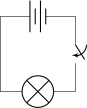
Heating effect of electric current: When current passes through a wire, the wire gets hot. This is utilized in devices like electric heaters and fuses. In a bulb, the filament reaches such a high temperature that it starts glowing.

Magnetic effect of electric current: A current-carrying wire behaves like a magnet. This was discovered by Hans Christian Oersted when he noticed a compass needle deflect near a wire when the switch was turned 'ON'.

📐Formulae
💡Examples
Problem 1:
A bulb in a closed circuit does not glow. Upon inspection, the filament is found to be broken. Explain why the bulb does not glow using circuit terminology.
Solution:
When the filament is broken, the bulb is said to be 'fused'.
Explanation:
A broken filament means there is a gap in the path of the electricity. This creates an 'Open Circuit', preventing the flow of current () from the positive () terminal to the negative () terminal. Without the flow of current, the heating effect cannot occur, and the bulb does not glow.
Problem 2:
What happens to a magnetic compass needle kept near a wire when the switch is turned 'ON'?
Solution:
The magnetic compass needle will show a deflection.
Explanation:
When the switch is 'ON', the circuit is closed and current () flows through the wire. This current creates a magnetic field around the wire (Magnetic Effect of Current), which exerts a force on the compass needle, causing it to move from its North-South alignment.
Problem 3:
In the following circuit diagram, the bulb does not glow even when the switch is in the 'ON' position. Identify the mistake in the cell connections.

Solution:
The two cells are connected with their negative () terminals touching each other. In a battery, the positive () terminal of one cell must be connected to the negative () terminal of the next cell for current to flow.
Explanation:
Electricity flows only when there is a proper potential difference. Connecting negative-to-negative or positive-to-positive creates an opposing setup where the net voltage is zero if the cells are identical, preventing current flow ().
Problem 4:
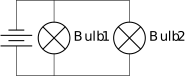
A student builds a circuit with a battery, a switch, and two bulbs. Draw the circuit such that if one bulb is removed, the other continues to glow. What is this type of connection called?
Solution:
This is a parallel circuit. Both bulbs are connected across the battery terminals independently.
Explanation:
In a parallel circuit, each component has its own separate path to the power source. If one path is broken (bulb removed), the other path remains closed, allowing the second bulb to continue glowing.