
Review the key concepts, formulae, and examples before starting your quiz.
🔑Concepts
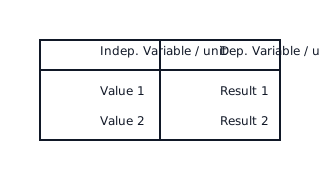
Data tables are used to organize measurements systematically. The independent variable (what you change) is placed in the first column, and the dependent variable (what you measure) is placed in the subsequent columns. Units must be included in the header, not in every cell.
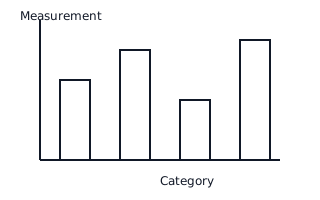
Bar charts are used when the independent variable is 'categoric' or discrete (labels/words). The bars should be of equal width and separated by equal gaps.
Line graphs are used for continuous data where both variables are numerical. Points should be plotted with an 'x' and connected with a line of best fit or smooth curve to show trends.
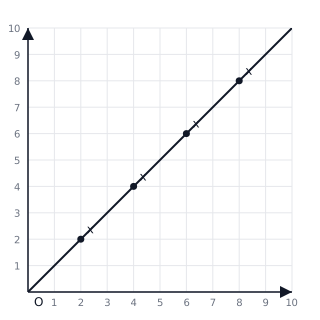
Scales on axes must be linear, meaning they increase by the same amount for every grid square. The range of the scale should cover all data points and utilize at least half of the available graph paper.
📐Formulae
💡Examples
Problem 1:
A student measures the temperature of water every minute for minutes as it cools. The readings are , , , , and . Should this data be recorded in a bar chart or a line graph?
Solution:
A line graph.
Explanation:
Since time and temperature are both continuous variables, a line graph is the best way to show the trend of the water cooling over the minute period.
Problem 2:
Calculate the mean (average) height of three plants measuring , , and .
Solution:
Explanation:
Using the formula:
Problem 3:
In a data table for an experiment testing how the amount of water affects plant height, which column should 'Amount of Water ()' be placed in?
Solution:
The first column (left side).
Explanation:
The amount of water is the independent variable (the factor being changed by the scientist), which by convention is placed in the first column of a data table.
Problem 4:
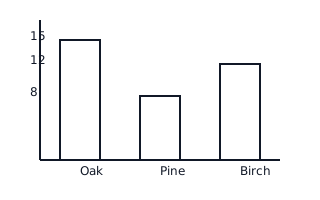
A researcher counts the number of insects found on different types of trees: Oak (15), Pine (8), and Birch (12). Draw a representation of how this data would be plotted on a bar chart and identify the independent variable.
Solution:
The independent variable is 'Type of Tree'. The bar chart should show 'Type of Tree' on the -axis and 'Number of Insects' on the -axis with bars of heights , , and respectively.
Explanation:
Because the tree types are discrete categories (names, not numbers), a bar chart is the correct choice. The height of each bar represents the frequency of insects.
Problem 5:
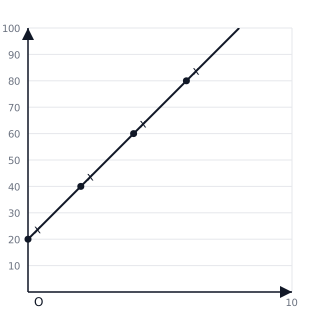
A student heats water and records the temperature every minutes. The data points recorded are . Plot these points on a graph and describe the relationship.
Solution:
The graph shows a linear relationship. For every minute increase in time, the temperature increases by . The formula for the temperature at time is .
Explanation:
Since both time and temperature are continuous numerical variables, a line graph is used. The points form a straight line, indicating a constant rate of heating.