
Review the key concepts, formulae, and examples before starting your quiz.
🔑Concepts
The brightness of a bulb is directly affected by the total voltage supplied by the battery; increasing the number of cells in series increases the total voltage, which pushes more current through the bulb, making it glow brighter.
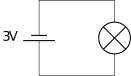
When more components (like bulbs) are added in series, the total resistance of the circuit increases. This higher resistance reduces the flow of current, causing each bulb to shine more dimly.
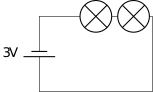
In a series circuit, the total voltage from the battery is shared between all the components. If the bulbs are identical, the voltage is shared equally. For example, in a circuit with 3 bulbs, each bulb receives .
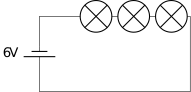
If the voltage remains constant but the number of components increases, the current () decreases because . This is why adding more bulbs without adding more batteries results in dimmer lights.
📐Formulae
💡Examples
Problem 1:
A simple circuit contains one cell and one bulb. If you add two more cells in series, what will happen to the brightness of the bulb?
Solution:
The bulb will shine significantly brighter.
Explanation:
By adding more cells, the total voltage increases from to . A higher voltage pushes more current through the circuit, increasing the energy delivered to the bulb.
Problem 2:
A circuit is powered by a battery and has one bulb. If a second identical bulb is added into the circuit in series, how does the brightness change?
Solution:
Both bulbs will be dimmer than the single bulb was originally.
Explanation:
Adding a second bulb increases the total resistance of the circuit. Furthermore, the from the battery is now shared between two bulbs, meaning each bulb only receives ().
Problem 3:
If a circuit has a battery and three identical bulbs in series, how much voltage does each bulb receive?
Solution:
Each bulb receives .
Explanation:
In a series circuit, the voltage is shared equally among identical components. Calculation: per bulb.
Problem 4:
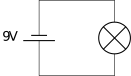
A student builds a circuit with two cells and one bulb. They then replace the two cells with a single battery. What will happen to the bulb, and why?
Solution:
The bulb will shine much brighter or may even 'blow' (the filament breaks). This happens because the voltage increases from () to . Since , the increased voltage forces a much higher current through the bulb.
Explanation:
Increasing the electrical 'push' (voltage) while keeping the resistance (one bulb) the same results in a higher current flow.
Problem 5:
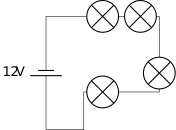
A circuit contains a power supply and four identical bulbs connected in series. Calculate the voltage drop across a single bulb and describe its brightness compared to a circuit with only two bulbs.
Solution:
The bulbs will be dimmer than in a two-bulb circuit because in a two-bulb circuit, each would receive .
Explanation:
In a series circuit, voltage is divided by the number of identical components. More components mean less voltage per component and higher total resistance, reducing the current.