
Review the key concepts, formulae, and examples before starting your quiz.
🔑Concepts
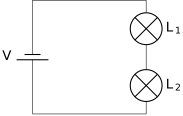
A series circuit is a single continuous loop where all components are connected one after another. In this arrangement, there is only one path for the electric current to flow.
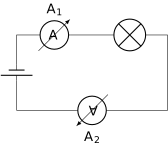
Current () is the same at every point in a series circuit. If you measure the current near the battery or between two bulbs, the value remains constant: .
The total voltage () provided by the power source is shared between the components. For example, if two identical bulbs are connected to a battery, each bulb receives .
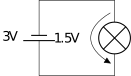
If any component in a series circuit breaks or is disconnected, the circuit becomes 'open'. This stops the flow of electricity entirely, and all other components will stop working.
📐Formulae
💡Examples
Problem 1:
A series circuit contains two cells and one bulb. What is the total voltage supplied to the bulb?
Solution:
Explanation:
In a series circuit, the voltages of the cells are added together to find the total voltage supplied to the components.
Problem 2:
An ammeter placed next to the battery in a series circuit reads . What would another ammeter read if it was placed between two bulbs further down the same circuit?
Solution:
Explanation:
In a series circuit, the current is the same at all points because there is only one path for the electricity to follow.
Problem 3:
If a series circuit has three bulbs and one bulb 'blows' (the filament breaks), what happens to the other two bulbs?
Solution:
The other two bulbs will turn off.
Explanation:
A 'blown' bulb creates a gap in the circuit. Since there is only one path in a series circuit, the break stops the flow of current entirely.
Problem 4:
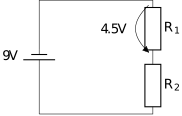
A series circuit consists of a battery and two identical resistors, and . If a voltmeter connected across measures , what is the voltage across ?
Solution:
Explanation:
In a series circuit, the sum of the voltages across individual components must equal the total voltage supplied by the battery. Since the resistors are identical, they share the voltage equally.
Problem 5:
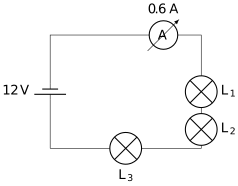
A series circuit is constructed using a battery and three identical lamps, , , and . If an ammeter placed after the battery reads , determine the current flowing through and the voltage drop across .
Solution:
- Current in a series circuit:
- Voltage in a series circuit with identical components: Since the lamps are identical,
Explanation:
In a series circuit, there is only one path for the electrons to flow, so the current () remains the same at all points. Therefore, the ammeter reading of applies to every component. The total voltage supplied by the battery is shared equally among identical components connected in series. Dividing the total voltage () by the number of lamps (3) gives the voltage for each.