
Review the key concepts, formulae, and examples before starting your quiz.
🔑Concepts
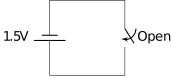
Circuit symbols are used to represent components in a circuit diagram. A switch controls the flow of electricity by opening or closing the path.

A buzzer is a component that converts electrical energy into sound energy. It must be connected in a complete circuit with a power source to function.
A motor is a component that converts electrical energy into kinetic (movement) energy. In a circuit diagram, it is represented by a circle with the letter 'M' inside.
Electric current can only flow through a closed circuit. If a switch is open, the path is broken and components like motors or buzzers will not operate.
📐Formulae
💡Examples
Problem 1:
A student builds a circuit with a battery, a switch, and a buzzer. If the switch is open, will the buzzer make a sound? If the student adds another cell in series, what is the new total voltage ?
Solution:
The buzzer will not make a sound while the switch is open. The new total voltage is .
Explanation:
An open switch creates a break in the circuit, meaning the current cannot flow. When adding cells in series, we add their voltages: .
Problem 2:
Identify the energy transformation that occurs when a battery is connected to a small electric motor in a closed circuit.
Solution:
Explanation:
The battery stores energy. This is converted to energy in the wires. The motor then converts this into (rotation), though some energy is always lost as due to friction and resistance.
Problem 3:
Draw the circuit symbol for a buzzer and a motor. How do they differ in function?
Solution:
Buzzer symbol: A semi-circle with two legs (like a mushroom). Motor symbol: A circle with a capital '' inside.
Explanation:
While both are output components, the buzzer is designed to create sound waves, whereas the motor is designed to create physical rotation or motion.
Problem 4:
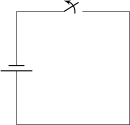
In the circuit shown, there is a battery, an open switch, and a buzzer. Describe what happens to the buzzer when the switch is moved to the closed position, and state the energy transformation occurring in the buzzer.
Solution:
When the switch is closed, the circuit is completed and an electric current flows. The buzzer will emit a sound. The energy transformation in the buzzer is from electrical energy to sound energy.
Explanation:
A circuit must be closed (complete) for current to flow. The buzzer is an output component that converts electrical energy into sound waves.
Problem 5:
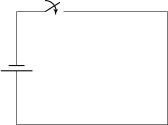
A student constructs a circuit with a battery, a closed switch, and an electric motor. If the battery provides a total voltage of and the student adds a second motor in series, explain the effect on the first motor's speed and provide the circuit schematic.
Solution:
The speed of the first motor will decrease. This is because the total voltage is now shared between two motors (), meaning each motor receives less energy per second.
Explanation:
In a series circuit, the total voltage is divided across the components. Since is lower for each motor compared to a single-motor circuit, the kinetic energy output (rotation speed) decreases.