
Review the key concepts, formulae, and examples before starting your quiz.
🔑Concepts
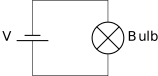
Electric current flows in a complete loop called a circuit. For electricity to flow, the circuit must be closed, meaning there are no breaks in the path.
Conductors are materials that allow electricity to flow through them easily, such as Copper () or Aluminum (). Insulators are materials that block the flow of electricity, such as rubber or wood.
A switch acts as a gate in a circuit. When the switch is 'Open', the circuit is broken and the current stops. When the switch is 'Closed', the path is complete and devices like bulbs will turn on.
Cells in series increase the total voltage. Adding more cells () provides more energy to the circuit, which can make a bulb glow brighter.

📐Formulae
💡Examples
Problem 1:
A student builds a circuit with a battery and a bulb that has a resistance of . Calculate the current () flowing through the circuit.
Solution:
Using the formula , we get .
Explanation:
By applying Ohm's Law, we divide the voltage by the resistance to find that the current is Amperes.
Problem 2:
Which material would be the best choice to complete a circuit: a piece of plastic ( based polymer) or a silver () paperclip?
Solution:
The silver () paperclip.
Explanation:
Silver is a metal and a strong conductor, meaning it has very low resistance (), allowing electrons to flow. Plastic is an insulator and will stop the flow of electricity.
Problem 3:
If two cells are placed in series in a flashlight, what is the total voltage () supplied to the bulb?
Solution:
Explanation:
When cells are connected in series, their voltages are added together to provide more energy to the circuit.
Problem 4:
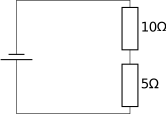
Calculate the total resistance () in a circuit where two resistors, and , are connected in a single loop (series).
Solution:
Explanation:
In a series circuit, the total resistance is the sum of all individual resistances along the path.
Problem 5:
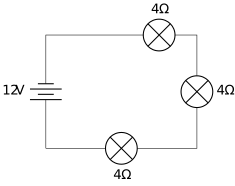
A circuit contains three identical light bulbs connected in series to a battery. Each bulb has a resistance of and the battery provides a total voltage of . Calculate the total current () flowing through the circuit.
Solution:
Explanation:
In a series circuit, the total resistance is the sum of all individual resistances. Once the total resistance () is found, Ohm's Law () is rearranged to to solve for the current. Using the battery voltage of and the total resistance of , we find that Ampere of current flows through the circuit.