
Review the key concepts, formulae, and examples before starting your quiz.
🔑Concepts
An electric circuit is a closed path through which electric current flows. It typically consists of a source (cell), a switch, connecting wires, and a load (bulb). Current flows from the positive terminal to the negative terminal of the cell when the switch is in the 'ON' position.
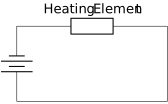
When electric current passes through a wire, the wire gets hot. This is known as the heating effect of electric current. Appliances like electric heaters, irons, and geysers use coils called 'elements' made of materials like Nichrome that produce high heat.
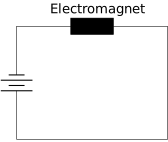
A magnetic field is produced around a conductor when current flows through it. This was discovered by Hans Christian Oersted. An electromagnet is created by winding a coil of insulated wire around a piece of magnetic material like soft iron.
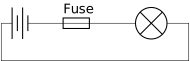
A fuse is a safety device used in electrical circuits to prevent damage from excessive current. It contains a thin wire with a low melting point that melts and breaks the circuit if the current exceeds a safe limit.
📐Formulae
💡Examples
Problem 1:
Why does a compass needle show deflection when brought near a wire through which electricity is flowing?
Solution:
The deflection occurs due to the magnetic effect of electric current.
Explanation:
When electric current flows through a conductor, it creates a magnetic field around it. This magnetic field exerts a force on the magnetic needle of the compass, causing it to move from its original North-South alignment.
Problem 2:
Calculate the total voltage if three cells, each of , are connected in series in a toy car circuit.
Solution:
Explanation:
When cells are connected in series, their individual voltages are added together to find the total voltage supplied to the circuit.
Problem 3:
A fuse wire is made of a material with a low melting point. What happens if the current flowing through it is too high?
Solution:
The wire melts and breaks the circuit.
Explanation:
According to the heating effect, heat increases as current increases (). If the current is too high, the heat generated exceeds the melting point of the fuse wire, causing it to melt and stop the flow of electricity, protecting the appliances.
Problem 4:
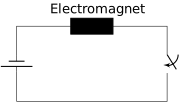
A student winds a copper wire around an iron nail and connects the ends to a cell and a switch. What will happen to a pile of steel paperclips placed near the nail when the switch is turned 'ON' and 'OFF'?
Solution:
- When the switch is 'ON', the paperclips will be attracted to the nail.
- When the switch is 'OFF', the paperclips will fall off.
Explanation:
When current flows through the coil, the iron nail becomes an electromagnet due to the magnetic effect of electric current. This magnetism attracts the steel paperclips. When the current is stopped by turning the switch 'OFF', the nail loses its magnetism and the clips fall.
Problem 5:
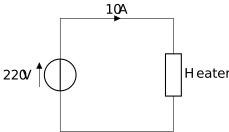
An electric heater is connected to a power source. If the current flowing through the heating element is , calculate the power consumed by the heater. Also, determine the total heat energy produced in Joules if the heater is used for seconds.
Solution:
Explanation:
The power is the product of voltage and current . The heat energy produced is the product of power and time . According to the heating effect of electric current, electrical energy is converted into heat energy when passing through a resistor.