
Review the key concepts, formulae, and examples before starting your quiz.
🔑Concepts
In a series circuit, there is only one path for the electric current () to flow; if the circuit is broken at any point, the current stops flowing everywhere.
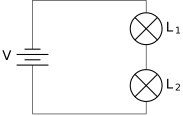
The current () remains the same at every point in a series circuit. This means .
The total resistance () of the circuit is the sum of the individual resistances of all components connected in series.
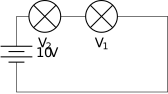
The total potential difference () supplied by the battery is shared between the components. The sum of the voltages across each component equals the battery voltage.
📐Formulae
💡Examples
Problem 1:
A series circuit consists of a battery connected to two resistors: and . Calculate the total current flowing through the circuit.
Solution:
First, calculate total resistance: . Then, use Ohm's Law: .
Explanation:
In a series circuit, resistances are additive. Once the total resistance is known, the constant current through the loop is found using the supply voltage.
Problem 2:
If a current of flows through a lamp for minutes, how much charge has passed through the lamp?
Solution:
Convert time to seconds: . Use the formula .
Explanation:
The unit of charge is the Coulomb (). Time must always be converted to the SI unit of seconds () before calculation.
Problem 3:
In a series circuit with a battery, the potential difference across a bulb is . What is the potential difference across the remaining resistor in the circuit?
Solution:
.
Explanation:
In a series circuit, the sum of the potential differences across all components must equal the total potential difference provided by the source.
Problem 4:
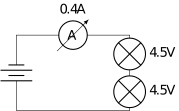
A circuit contains a battery and two identical bulbs. An ammeter measures a current of leaving the battery. If the voltage across one bulb is , what is the total voltage of the battery?
Solution:
- Identify the voltage across the second bulb: Since the bulbs are identical and the current is the same, the voltage across the second bulb is also .
- Calculate total voltage:
Explanation:
In a series circuit, identical components will share the total voltage equally. The sum of the potential differences across the lamps equals the electromotive force (EMF) of the battery.
Problem 5:
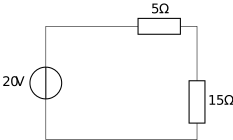
A series circuit is constructed with a DC power supply, a resistor, and a heating element. Calculate the total resistance of the circuit and the current flowing through the heating element.
Solution:
Explanation:
In a series circuit, the total resistance is the sum of the individual resistances. Since there is only one path for the current, the current is the same at all points in the circuit. Therefore, the current through the heating element is the same as the total current calculated using Ohm's Law.