
Review the key concepts, formulae, and examples before starting your quiz.
🔑Concepts
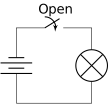
A complete circuit is a continuous path for electricity to flow. It requires a power source (like a battery), conductors (wires), and a load (like a bulb). If the path is broken by a switch or a gap, the electricity stops flowing.
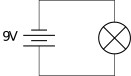
The flow of electricity is called current, measured in Amperes (). It flows from the positive () terminal to the negative () terminal of the battery in a conventional circuit.
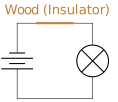
Insulators are materials like rubber, plastic, and glass that do not allow electricity to pass through easily. Conductors are materials like copper, aluminum, and silver that allow electricity to flow freely.
A switch is a device used to open or close a circuit. When the switch is 'ON' (closed), the circuit is complete. When the switch is 'OFF' (open), the gap prevents current flow.
📐Formulae
💡Examples
Problem 1:
A student builds a circuit with a battery and a light bulb. If the wire is disconnected from one terminal of the battery, will the bulb light up? Why?
Solution:
No, the bulb will not light up.
Explanation:
For electricity to flow, there must be a continuous 'closed loop'. By disconnecting the wire, the student creates an 'open circuit', which breaks the path for the electrons to travel from the negative terminal to the positive terminal.
Problem 2:
Identify which of the following materials would be the best conductor to complete a circuit: a plastic ruler, a wooden stick, or an iron () nail.
Solution:
The iron () nail.
Explanation:
Metals like iron () are excellent conductors because they have free electrons that allow electrical energy to pass through easily. Plastic and wood are insulators and do not allow electricity to flow.
Problem 3:
If a circuit has a voltage of and the current flowing is , calculate the resistance using Ohm's Law.
Solution:
Explanation:
Using the formula , we substitute the values: . The resistance of the circuit is Ohms.
Problem 4:
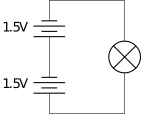
A student sets up a circuit with two batteries connected in a row and one bulb. If each battery provides of electrical push, what is the total voltage pushing the electricity through the bulb?
Solution:
Explanation:
When batteries are connected in a series (one after the other), their voltages add up to provide a stronger push to the electrons.
Problem 5:
Consider a simple circuit consisting of a battery, a switch, and a resistor representing a small motor with a resistance of . Calculate the current flowing through the circuit when the switch is closed, and draw the circuit diagram.
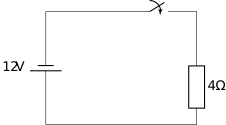
Solution:
Using Ohm's Law:
Explanation:
When the switch is closed, the circuit is complete. The current is calculated by dividing the total voltage () by the total resistance (). Here, divided by gives a current of Amperes ().