
Review the key concepts, formulae, and examples before starting your quiz.
🔑Concepts
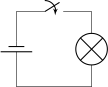
A simple electric circuit consists of a source of energy (cell), a path for current (wires), a switch, and a load (bulb). When the switch is in the 'ON' position, the circuit is closed and current flows.
The Heating Effect: When an electric current passes through a high-resistance wire, like the filament of a bulb or the element of a heater, the wire becomes hot and produces heat.
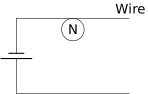
The Magnetic Effect: A current-carrying wire behaves like a magnet. This can be observed by placing a magnetic compass near the wire; the needle will deflect when the current starts flowing.
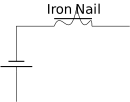
An Electromagnet is a coil of wire wound around a soft iron core. It acts as a magnet only as long as the electric current flows through the coil.
📐Formulae
💡Examples
Problem 1:
If a compass needle is placed near a wire and the switch is turned , why does the needle deflect?
Solution:
The needle deflects due to the Magnetic Effect of Electric Current.
Explanation:
When current flows through the wire, it creates a magnetic field around it. This magnetic field exerts a force on the compass needle, causing it to move from its original position.
Problem 2:
Why does the thin wire (filament) inside an electric bulb glow white-hot?
Solution:
It glows due to the Heating Effect of Current.
Explanation:
The filament is made of material with high resistance. When current flows through it, the electrical energy is converted into heat energy (), making it so hot that it begins to emit light.
Problem 3:
What is the difference between a magnet and an electromagnet?
Solution:
An electromagnet is a temporary magnet.
Explanation:
Unlike a permanent magnet, an electromagnet only shows magnetic properties when electric current is flowing through its coils. It can be turned or using a switch.
Problem 4:
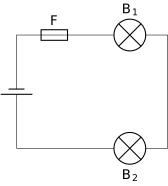
Look at the circuit diagram provided. If the fuse wire 'F' melts due to excessive current, what will happen to the two bulbs and ?
Solution:
Both bulbs and will stop glowing immediately.
Explanation:
The fuse is connected in series with the rest of the circuit. If the fuse wire melts, it breaks the path for the electric current. Since the circuit becomes 'open', no current can reach bulbs or .
Problem 5:
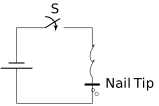
In the experimental setup shown, a wire is coiled around an iron nail and connected to a battery. Why are the iron pins attracted to the tip of the nail only when the switch 'S' is closed?
Solution:
The iron nail becomes an electromagnet when the switch is closed.
Explanation:
Closing the switch 'S' allows current to flow through the coil. This creates a magnetic field around the coil which magnetizes the iron nail. The magnetized nail then attracts the iron pins. When the switch is opened, the magnetism is lost.