
Review the key concepts, formulae, and examples before starting your quiz.
🔑Concepts
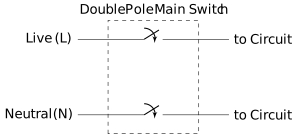
The Main Switch and Consumer Unit: Power enters a house via the mains cable (Phase/Live and Neutral). The main switch is a double-pole switch that disconnects both the Live and Neutral wires simultaneously for safety during maintenance.
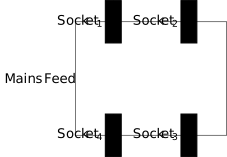
The Ring System of Wiring: In modern houses, appliances are connected in a ring circuit. This allows the current to reach an appliance through two paths, effectively doubling the current carrying capacity of the wires and reducing the required thickness of the copper used.
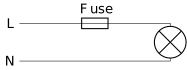
The Fuse: A safety device consisting of a short length of wire with a low melting point. It is always connected in series with the Live wire. If the current exceeds the safe limit, the fuse melts and breaks the circuit.
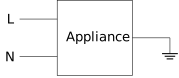
Earthing: The process of connecting the metallic body of an appliance to the Earth. If a fault occurs and the Live wire touches the metal casing, the current flows to the Earth instead of through the user, preventing electric shocks.
📐Formulae
💡Examples
Problem 1:
An electric heater is rated . Calculate the current drawn by the heater and the appropriate fuse rating.
Solution:
Given: , . Using the formula : . The fuse rating should be slightly higher than the operating current, so a or fuse is appropriate.
Explanation:
The heater draws a steady current of during normal operation. A fuse rating of might melt due to minor fluctuations, so a slightly higher capacity is chosen for safety.
Problem 2:
Why is the Earth pin in a three-pin plug made longer and thicker than the other two pins?
Solution:
The Earth pin is made longer so that it makes contact with the earth socket first, before the live and neutral pins connect. It is made thicker so that it cannot be inserted into the live or neutral holes of the socket.
Explanation:
The longer pin ensures the safety of the user by grounding the appliance body before power is supplied. The thickness acts as a safety 'key' to prevent incorrect electrical connections.
Problem 3:
If a circuit has a total power load of on a line, will a fuse blow?
Solution:
Total current . Since the current drawn () is greater than the fuse rating (), the fuse will blow.
Explanation:
A fuse melts when the current passing through it exceeds its rated capacity. In this case, the load requires more current than the fuse can safely handle, indicating an overload.
Problem 4:
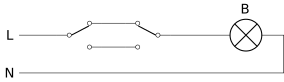
A staircase lighting circuit uses two switches and to operate a single bulb . Draw the circuit diagram where the bulb can be turned ON or OFF from either the top or bottom of the stairs.
Solution:
When both switches are connected to the same wire (either upper or lower), the circuit is complete. If they are in different positions, the circuit is broken.
Explanation:
Two-way switches allow the current to flow through one of two parallel paths. Moving either switch toggles the state of the circuit regardless of the other switch's position.
Problem 5:
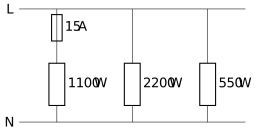
Calculate the total current flowing into a house circuit if three appliances—a toaster, a air conditioner, and a refrigerator—are all operating simultaneously on a line. Determine if a main fuse will blow.
Solution:
- Calculate total power:
- Calculate total current:
- Since , the fuse will blow.
Explanation:
In a household circuit, appliances are connected in parallel. The total current is the sum of currents drawn by each appliance. If this sum exceeds the fuse rating, the fuse wire melts.