
Electromagnetic Induction and Alternating Currents - Alternating Current (LCR Circuits, Resonance)
Review the key concepts, formulae, and examples before starting your quiz.
🔑Concepts
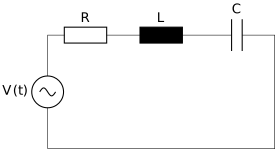
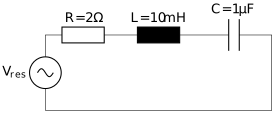
The series circuit consists of an inductor (), a capacitor (), and a resistor () connected in series to an AC source . The total opposition to current is called impedance ().
The phase relationship between voltage and current in an circuit is represented using a Phasor Diagram. The voltage across the resistor () is in phase with current, leads by , and lags by .
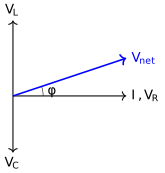
Resonance occurs when the inductive reactance equals the capacitive reactance (). At this frequency, , meaning impedance is at its minimum and current is at its maximum value .
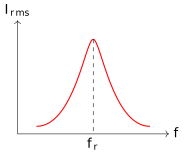
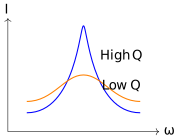
The Quality Factor () measures the sharpness of resonance. A high value indicates a sharp peak and high selectivity, calculated as the ratio of the voltage across or to the voltage across at resonance.
📐Formulae
💡Examples
Problem 1:
A series circuit contains a resistor of , an inductor of , and a capacitor of . Calculate the resonant frequency of the circuit.
Solution:
Given: , . Using the formula : .
Explanation:
Resonant frequency is the frequency at which the inductive reactance equals capacitive reactance, causing the circuit to behave as purely resistive.
Problem 2:
In an circuit, , , and . Find the impedance and the power factor.
Solution:
Power factor .
Explanation:
The impedance is the total resistance of the circuit. The power factor is the cosine of the phase angle, indicating how much of the supplied power is actually dissipated as heat.
Problem 3:
An alternating voltage source is connected in series with a resistor , an inductor , and a capacitor . Calculate the peak current flowing through the circuit and the phase difference between the voltage and the current.
Solution:
- Identify given values: , , , , .
- Calculate Inductive Reactance:
- Calculate Capacitive Reactance:
- Calculate Impedance ():
- Calculate Peak Current ():
- Calculate Phase Difference (): (The negative sign indicates the current leads the voltage since .)
Explanation:
First, we determine the individual reactances of the inductor and capacitor using the angular frequency provided in the voltage equation. Then, we find the total impedance by combining resistance and the net reactance. Finally, we use Ohm's law for AC to find peak current and use the tangent ratio for phase angle.
Problem 4:
A series circuit is in resonance. The inductance , the capacitance , and the resistance . Find the Quality Factor (-factor) of the circuit and calculate the bandwidth .
Solution:
- Identify given values: , , .
- Calculate resonant angular frequency ():
- Calculate Q-factor:
- Calculate Bandwidth ():
Explanation:
At resonance, the -factor represents the sharpness of the resonance peak. It is calculated using the circuit parameters and . The bandwidth is the range of frequencies over which the power is at least half of the maximum power, and it is inversely proportional to the -factor.