
Review the key concepts, formulae, and examples before starting your quiz.
🔑Concepts
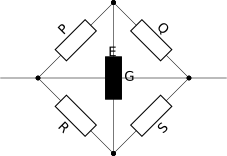
The Wheatstone Bridge is an electrical circuit used to measure an unknown electrical resistance by balancing two legs of a bridge circuit. When the galvanometer shows zero deflection, the bridge is said to be balanced and the condition holds true.
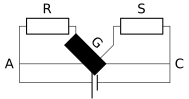
A Metre Bridge is a practical form of the Wheatstone Bridge. It consists of a wire of length (usually constantan or manganin). A jockey is moved along the wire to find the null point where the galvanometer deflection is zero.
A Potentiometer measures EMF or potential difference without drawing any current from the source, making it an ideal voltmeter. It works on the principle that the potential drop across a uniform wire is directly proportional to its length: (when current is constant).
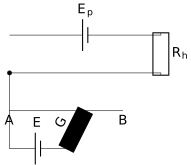
Potential Gradient () is the potential drop per unit length of the potentiometer wire. It is given by . Lowering the value of increases the sensitivity of the potentiometer.
📐Formulae
💡Examples
Problem 1:
In a Metre Bridge, the balance point is found at a distance of from end when a resistor is in the left gap and an unknown resistor is in the right gap. Calculate the value of .
Solution:
Given and . Using the Metre Bridge formula: . Substituting the values: .
Explanation:
The Metre Bridge works on the Wheatstone principle where the ratio of resistances equals the ratio of the lengths of the wire segments.
Problem 2:
A potentiometer wire has a length of and a resistance of . A cell of EMF is connected across it. Calculate the potential gradient.
Solution:
Length , Resistance , . Potential gradient . To convert to : .
Explanation:
Potential gradient is the potential drop divided by the total length of the potentiometer wire.
Problem 3:
With a cell of EMF in the secondary circuit of a potentiometer, the balance point is . When a resistor of is connected across the cell, the balance point shifts to . Find the internal resistance of the cell.
Solution:
Given , , and external resistance . Internal resistance . .
Explanation:
The internal resistance is calculated by comparing the balancing length of the cell in open circuit () and closed circuit ().
Problem 4:
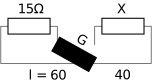
In a Metre Bridge experiment, the balance point is obtained at from the left end. If the resistance in the left gap is , determine the value of the unknown resistance in the right gap. If the resistors are interchanged, what will be the new balance length?
Solution:
-
Using the Wheatstone Bridge principle for a Metre Bridge:
-
When resistors are interchanged, the new balance length is:
Explanation:
The ratio of resistances in the gaps equals the ratio of the lengths of the wire segments. Interchanging the resistors simply swaps the segments, moving the balance point from to .
Problem 5:
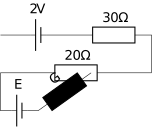
A potentiometer has a wire of length and resistance . It is connected in series with a battery and a external resistor. Find the potential gradient of the wire and the EMF of a cell that balances at .
Solution:
-
Total resistance of primary circuit:
-
Current in the circuit:
-
Potential drop across wire ():
-
Potential gradient ():
-
EMF of the cell (): Note: .
Explanation:
First find the total resistance of the primary circuit to calculate the current. Use this current to find the potential drop across the potentiometer wire, then divide by its length to get the gradient.