
Review the key concepts, formulae, and examples before starting your quiz.
🔑Concepts
Ampere’s Circuital Law (ACL) relates the integrated magnetic field around a closed loop (called an Amperian loop) to the electric current passing through the loop. It states that the line integral of magnetic field around any closed path is equal to times the total current threading through the loop: .
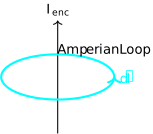
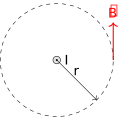
The Amperian loop is a mathematical construct, similar to a Gaussian surface. For a long straight wire, the magnetic field lines form concentric circles. By choosing a circular Amperian loop of radius centered on the wire, the magnetic field is constant in magnitude and tangent to the loop at every point, simplifying the integral to .
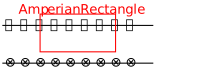
In an ideal long solenoid, the magnetic field is uniform and parallel to the axis inside, while it is approximately zero outside. Applying ACL to a rectangular loop (with one side inside and one side outside) shows that , where is the number of turns per unit length.
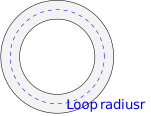
A toroid is essentially a solenoid bent into a circle to form a closed ring. The magnetic field is confined within the core of the toroid. According to ACL, for a loop of radius inside the core, the enclosed current is , resulting in a field .
📐Formulae
💡Examples
Problem 1:
A long solenoid has turns per meter and carries a current of . Calculate the magnetic field at the center of the solenoid. Take .
Solution:
Given and . Using the formula for a solenoid: .
Explanation:
The magnetic field inside a solenoid is directly proportional to the number of turns per unit length () and the current (). Since the solenoid is 'long', we use the formula for an ideal solenoid.
Problem 2:
A toroid has a core of inner radius and outer radius around which turns of a wire are wound. If the current in the wire is , what is the magnetic field inside the core of the toroid?
Solution:
Mean radius . Total turns , Current . Formula for toroid: .
Explanation:
For a toroid, the magnetic field is calculated using the mean radius of the circular path. The field exists only within the cross-section of the toroid core.
Problem 3:
A long straight solid conductor of radius carries a steady current . The current is uniformly distributed across its cross-section. Use Ampere's Circuital Law to find the magnetic field at a distance where .
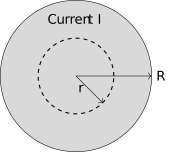
Solution:
- For , the current enclosed is a fraction of the total current based on the area ratio:
- Applying Ampere's Law:
- Solving for : This shows the field increases linearly with inside the conductor.
Explanation:
Inside a conductor with uniform current density, only the current within the cylinder of radius contributes to the magnetic field at that radius.
Problem 4:
A cylindrical cable consists of a thin inner wire and a concentric outer thin cylindrical shell of radius . The wire carries current in one direction and the shell carries the same current in the opposite direction. Find the magnetic field at a point outside the cable ().
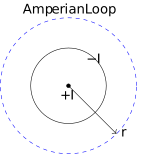
Solution:
- Choose a circular Amperian loop of radius centered on the cable.
- The total current enclosed by this loop is the algebraic sum of the currents:
- Since the currents are equal and opposite:
- Applying Ampere's Law: Thus, the magnetic field outside a coaxial cable with equal and opposite currents is zero.
Explanation:
Because the net current enclosed by the Amperian loop outside the cable is zero, the magnetic field in that region is also zero.