
Review the key concepts, formulae, and examples before starting your quiz.
🔑Concepts
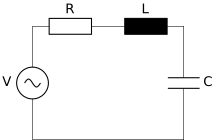
The LCR series circuit consists of an inductor (), a capacitor (), and a resistor () connected in series to an alternating voltage source . The same current flows through all components, but the voltages across them have different phase relationships.
Phasor diagrams represent the voltage vectors: is in phase with current , leads by (), and lags by . The resultant voltage is the vector sum of these components.
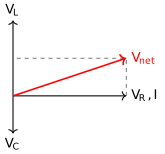
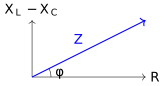
Impedance () is the total effective resistance of the circuit. The phase angle between current and voltage is determined by the relative values of inductive reactance () and capacitive reactance ().
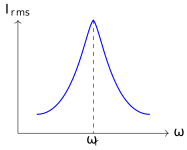
At resonance, , making the impedance minimum and equal to . This results in maximum current . The circuit behaves purely resistively, and the power factor becomes unity ().
📐Formulae
💡Examples
Problem 1:
In a series LCR circuit, , , and are connected to a , AC source. Calculate (i) the reactance of the circuit and (ii) the impedance.
Solution:
Given: , , , .
- Inductive Reactance: .
- Capacitive Reactance: .
- Net Reactance: .
- Impedance: .
Explanation:
We first calculate the individual reactances using the frequency provided. Since , the circuit is predominantly inductive. The impedance is then found using the Pythagorean relationship between resistance and net reactance.
Problem 2:
Calculate the resonant frequency and the Quality factor () of a series LCR circuit with , , and .
Solution:
Given: , , .
- Resonant angular frequency: .
- Quality factor: .
Explanation:
The resonant frequency is the frequency at which , making the circuit purely resistive. The factor is a dimensionless quantity that characterizes the circuit's bandwidth and damping.
Problem 3:
A series LCR circuit has , , and connected to an AC source of . Determine the phase angle between the voltage and the current, and calculate the power factor of the circuit.
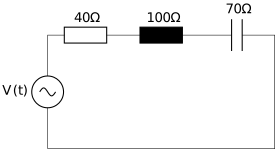
Solution:
-
Calculate the phase angle using the formula:
-
The power factor is given by : First, find Impedance :
-
Calculate Power Factor: Since , the current lags the voltage.
Explanation:
The phase angle represents the time lag or lead between current and voltage. Since the inductive reactance is greater than the capacitive reactance, the circuit is inductive, meaning the current lags the voltage by . The power factor of 0.8 indicates that 80% of the apparent power is being converted into real power.
Problem 4:
A series LCR circuit is connected to an AC source of , . The circuit contains a resistor , an inductor , and a capacitor . Determine the RMS current () flowing through the circuit and the power factor.
Solution:
Explanation:
First, calculate the inductive and capacitive reactances using the source frequency. Then, find the total impedance () of the series combination. The RMS current is found using Ohm's law for AC (). The power factor is the ratio of resistance to impedance.