
Review the key concepts, formulae, and examples before starting your quiz.
🔑Concepts
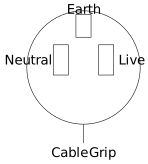
Mains electricity in most countries is an Alternating Current (a.c.) supply, typically around and . A standard three-pin plug connects appliances to the mains using three wires: Live (brown), Neutral (blue), and Earth (yellow/green).
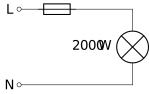
The Fuse is a safety component containing a thin wire that melts if the current exceeds a specific value (), breaking the circuit. It is always connected to the Live wire to ensure the appliance is isolated from the high voltage if the fuse blows.

Circuit breakers (like MCBs) act faster than fuses and can be reset without replacement. They use electromagnets or bimetallic strips to detect over-current conditions and mechanically trip a switch to open the circuit.
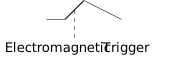
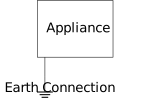
The Earth wire is a safety wire connecting the metal casing of an appliance to the ground. If a fault occurs and the Live wire touches the casing, a large current flows through the Earth wire to the ground, blowing the fuse and preventing electric shock.
Double insulation is used for appliances with plastic casings. Since plastic is an insulator, the casing cannot become live even if an internal wire comes loose, so these appliances do not require an Earth wire and are marked with a 'square-in-a-square' symbol.

📐Formulae
💡Examples
Problem 1:
An electric heater is rated at and is connected to a mains supply. Calculate the current flowing through the heater and suggest an appropriate fuse rating from the following: , , .
Solution:
Explanation:
Since the operating current is , the fuse must have a rating slightly higher than this to allow normal operation but blow during a fault. Therefore, a fuse is the correct choice.
Problem 2:
Calculate the electrical energy transferred in Joules by a light bulb left on for hours.
Solution:
Explanation:
Energy is the product of power and time. Time must be converted from hours to seconds () to get the result in Joules ().
Problem 3:
A hairdryer consumes of energy when used for minutes at a potential difference of . Calculate the power of the hairdryer and the current flowing through it.
Solution:
- Convert energy to Joules: .
- Convert time to seconds: .
- Calculate Power using :
- Calculate Current using :
Explanation:
Power is defined as the rate of energy transfer. By converting units to SI (Joules and seconds), we find the power in Watts. Dividing the power by the mains voltage gives the current in Amperes.
Problem 4:
An electric iron with a resistance of is connected to a standard mains supply. Calculate the power dissipated by the iron and determine the energy used if it is operated for minutes. Illustrate the basic circuit connection of the iron to the mains including a fuse.
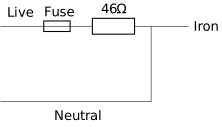
Solution:
Explanation:
First, the power is calculated using the formula because the voltage and resistance are known. Then, the time is converted from minutes to seconds (SI units) to calculate the energy transferred using .