
Review the key concepts, formulae, and examples before starting your quiz.
🔑Concepts
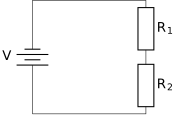
In a series circuit, there is only one path for the current to flow. Therefore, the current remains constant through every component, while the total potential difference is shared among the components such that .
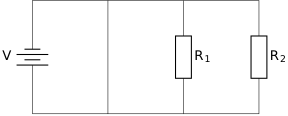
In a parallel circuit, there are multiple branches for the current to follow. The potential difference across each branch is the same and equal to the source voltage, while the total current splits between the branches: .
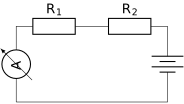
Adding more resistors in series increases the total resistance of the circuit, which decreases the total current. Conversely, adding more resistors in parallel provides more paths for current, which decreases the total equivalent resistance and increases the total current drawn from the source.
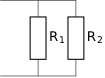
The combined resistance of two resistors in parallel is always less than the resistance of the smallest individual resistor. This is because the total cross-sectional area for the current to flow through has effectively increased.
📐Formulae
💡Examples
Problem 1:
Two resistors, and , are connected in series to a battery. Calculate the total current flowing through the circuit.
Solution:
Explanation:
First, find the total resistance by adding the individual resistances in series. Then, use Ohm's Law () to solve for the current.
Problem 2:
Two resistors, and , are connected in parallel. What is the total resistance of this combination?
Solution:
Explanation:
For parallel circuits, use the reciprocal formula. After summing the fractions, remember to take the reciprocal of the result to find . Note that is less than both and .
Problem 3:
In a parallel circuit with a supply, branch A has a resistor and branch B has a resistor. Calculate the current in branch A.
Solution:
Explanation:
In a parallel circuit, the voltage across each branch is equal to the source voltage. We can apply Ohm's Law directly to the specific branch.
Problem 4:
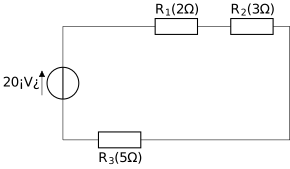
A DC power supply is connected to a series circuit containing three resistors: , , and . Calculate the potential difference (voltage drop) across the resistor.
Solution:
Explanation:
First, the total resistance of the series circuit is found by summing the individual resistances. Next, Ohm's law is used to find the total current, which is the same through every component in a series circuit. Finally, the voltage drop across the specific resistor is calculated using .
Problem 5:
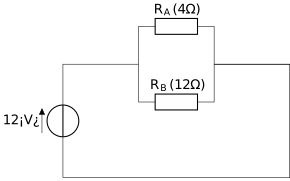
A battery is connected to two resistors in parallel. and . Determine the total current leaving the battery.
Solution:
Explanation:
In a parallel circuit, the reciprocal of the total resistance is the sum of the reciprocals of individual resistances. After finding , the total current is calculated using the battery voltage and the equivalent resistance of the network.