
Review the key concepts, formulae, and examples before starting your quiz.
🔑Concepts
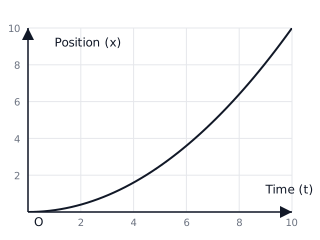
The position-time () graph represents the motion of an object over time. The slope of the tangent at any point on this graph gives the instantaneous velocity . A straight line indicates constant velocity, while a curve indicates acceleration.
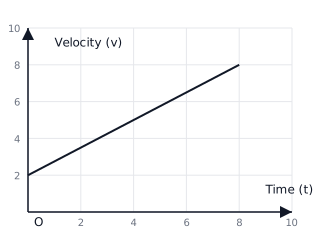
In a velocity-time () graph, the slope of the line represents the acceleration . A horizontal line represents zero acceleration (constant velocity), while a line with a constant non-zero slope represents uniform acceleration.
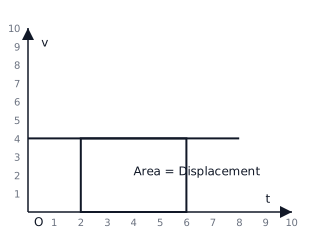
The area under the velocity-time graph between two time intervals and gives the displacement of the object during that interval. Displacement is the algebraic sum of areas (considering signs), while distance is the sum of absolute magnitudes of areas.
An object at rest is represented by a horizontal line in an graph (). In a graph, an object at rest or moving with constant velocity has a slope of zero ().
📐Formulae
💡Examples
Problem 1:
A car starts from rest and accelerates uniformly to a velocity of in . It then moves with this constant velocity for and finally comes to rest in with uniform retardation. Calculate the total displacement using a graph.
Solution:
The motion is divided into three parts:
- Acceleration phase (0 to 10s): Area of triangle .
- Constant velocity phase (10 to 30s): Area of rectangle .
- Retardation phase (30 to 35s): Area of triangle . Total Displacement .
Explanation:
Displacement is found by calculating the total area under the graph. The graph forms a trapezium, and the area is the sum of the areas of the geometric shapes formed.
Problem 2:
The graph for a particle is a parabola given by . Find the velocity of the particle at .
Solution:
Given . Velocity . At , .
Explanation:
The velocity is the slope of the position-time graph. By differentiating the position function with respect to time, we obtain the instantaneous velocity at any given time .
Problem 3:
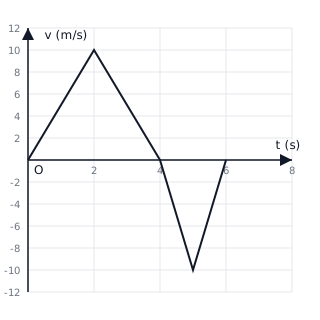
A particle moves according to the velocity-time graph shown. Find the total distance covered and the displacement of the particle from to .
Solution:
- Area of triangle from to : .
- Area of triangle from to : .
- Total Displacement .
- Total Distance .
Explanation:
Displacement is the vector sum of areas under the graph, whereas distance is the scalar sum of the magnitudes of those areas.
Problem 4:
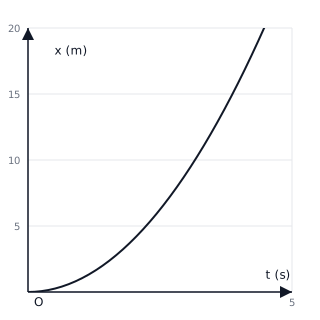
A body starts from the origin and its velocity increases linearly with time as . Plot the graph for the first and find its position at .
Solution:
Given . Integrating both sides: . . At , .
Explanation:
Since velocity is a linear function of time, position is a quadratic function of time, resulting in a parabolic graph.