
Practical Geometry - Construction of Quadrilaterals given different conditions (sides, diagonals, angles)
Review the key concepts, formulae, and examples before starting your quiz.
🔑Concepts
A quadrilateral is uniquely determined if five independent measurements are given. These can be various combinations of sides, diagonals, and angles.
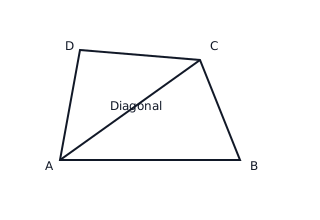
Case 1: Construction given four sides and one diagonal (). We treat the quadrilateral as two triangles sharing a common base (the diagonal).
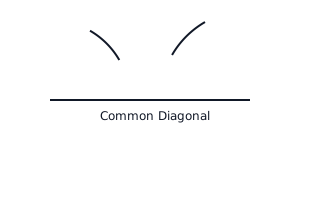
Case 2: Construction given three sides and two diagonals (). This involves constructing one triangle first and then finding the fourth vertex using the second diagonal.
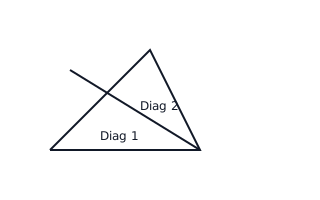
Case 3: Construction given two adjacent sides and three angles (). We first construct the given sides and then use the angles at the endpoints to find the intersection for the final vertex.
Case 4: Construction given three sides and two included angles (). We draw the central side, construct the two angles, and then mark off the other two sides along these angle arms.
📐Formulae
Sum of interior angles of a quadrilateral:
Area of a general quadrilateral given a diagonal and perpendiculars from opposite vertices:
Area of a Rhombus using diagonals and :
Area of a Parallelogram:
Property of Rhombus Diagonals: (They are perpendicular bisectors of each other)
💡Examples
Problem 1:
Construct a quadrilateral where and diagonal .
Solution:
- Draw a line segment .
- With as center and radius , draw an arc.
- With as center and radius (the diagonal), draw another arc to intersect the previous arc at point .
- Join and . This completes .
- Now, with as center and radius , draw an arc on the side opposite to .
- With as center and radius , draw an arc to intersect the previous arc at point .
- Join and .
- is the required quadrilateral.
Explanation:
This construction uses the 'Four Sides and One Diagonal' condition. The diagonal splits the quadrilateral into two triangles, and , both of which are constructed using the SSS (Side-Side-Side) rule.
Problem 2:
Construct a quadrilateral where and .
Solution:
- Draw line segment .
- At point , construct an angle using a protractor or compass.
- From the ray starting at , cut off a length using a compass.
- At point , construct an angle of relative to the segment .
- At point , construct an angle of relative to the segment .
- Extend the rays from point and point until they intersect. Label the point of intersection as .
- is the required quadrilateral.
Explanation:
This construction follows the 'Two Adjacent Sides and Three Angles' condition. By starting with side and its adjacent angles, we establish the positions of and . The final vertex is found by the intersection of the rays formed by the remaining angles.
Problem 3:
Construct a quadrilateral where , and .
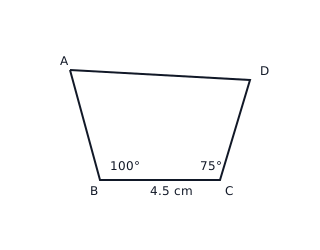
Solution:
- Draw a line segment .
- At point , construct .
- On the ray , mark a point such that .
- At point , construct .
- On the ray , mark a point such that .
- Join and . is the required quadrilateral.
Explanation:
This is a Case 4 construction (three sides and two included angles). We start with side because the angles at both its endpoints are known.
Problem 4:
Construct a rhombus with diagonals and .
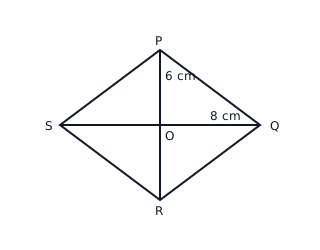
Solution:
- Draw a line segment .
- Construct the perpendicular bisector of . Let it meet at point .
- Since diagonals of a rhombus bisect each other at right angles, mark points and on the bisector such that .
- Join and . is the required rhombus.
Explanation:
A rhombus is a special quadrilateral. Given only two diagonals, we utilize the property that they are perpendicular bisectors of each other.