
Review the key concepts, formulae, and examples before starting your quiz.
🔑Concepts
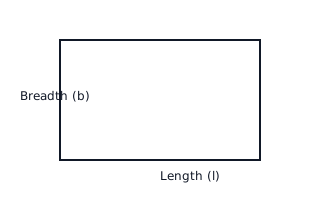
The area of a rectangle is the region enclosed by its four sides. It is calculated by multiplying the length () by the breadth (). For a square, since length equals breadth (), the area is .
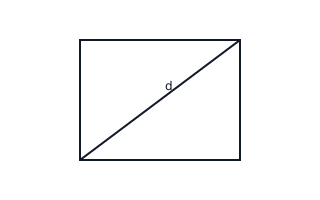
The diagonal of a rectangle or square can be calculated using the Pythagorean theorem. For a rectangle, the diagonal . For a square, the diagonal .
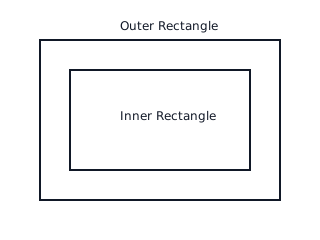
Area of a Path: To find the area of a path around a rectangular field, calculate the area of the outer rectangle and subtract the area of the inner rectangle.
Converting units of area is crucial: and .
📐Formulae
, where is length and is breadth.
, where is the side length.
💡Examples
Problem 1:
Find the area of a square plot of land whose perimeter is .
Solution:
Step 1: Find the side of the square.
Step 2: Calculate the area. .
Explanation:
To find the area, we first determine the side length from the given perimeter using the formula , then apply the area formula .
Problem 2:
A rectangular room measures by . A carpet is laid on the floor leaving a margin of all around. Find the area of the carpet.
Solution:
Length of the room () = Breadth of the room () = Margin width =
Dimensions of the carpet: Length () = Breadth () =
.
Explanation:
Since a margin is left on all sides, we subtract twice the margin width from both the length and the breadth to find the dimensions of the carpeted area.
Problem 3:
A rectangular park is long and wide. A path wide is constructed outside the park. Find the area of the path.
Solution:
Area of the park (Inner Rectangle) = .
Outer dimensions (including the path): Outer Length = Outer Breadth = Outer Area = .
Area of Path = Outer Area - Inner Area: Area of path = .
Explanation:
When the path is outside, we add twice the width of the path to the original dimensions to get the outer dimensions. The path area is the difference between the outer and inner rectangular areas.
Problem 4:
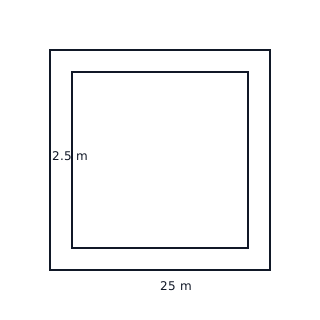
A square courtyard has a side of . A path wide is built inside it along the boundary. Find the area of the path.
Solution:
- Side of outer square () =
- Area of outer square =
- Width of path = . The inner square side () =
- Area of inner square =
- Area of path = Outer Area - Inner Area =
Explanation:
Since the path is inside the boundary, we subtract the width twice from the total length to find the inner dimension.
Problem 5:
Find the length of a rectangular plot whose area is and breadth is . Also, find the cost of fencing it at the rate of Rs per meter.
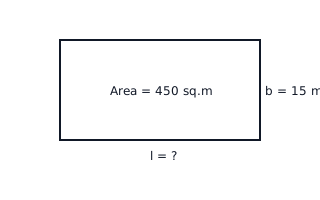
Solution:
- Area =
- Perimeter =
- Cost of fencing = Total Cost = Rs 1800
Explanation:
We first use the area formula to find the missing length, then find the perimeter to calculate the total length of fencing required.