
Application of Integrals - Applications in finding the area under simple curves (lines, circles, parabolas, ellipses)
Review the key concepts, formulae, and examples before starting your quiz.
🔑Concepts
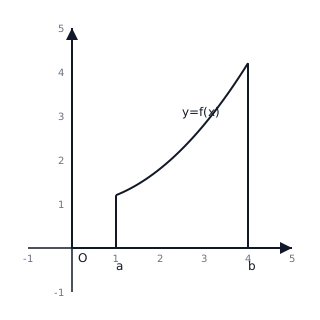
The area of the region bounded by the curve , the -axis, and the vertical lines and is given by . If the curve lies entirely above the -axis in , the area is simply .
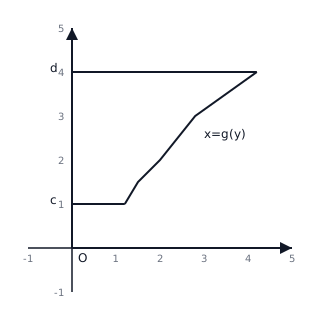
For curves bounded by the -axis and horizontal lines and , the area is calculated using . This is particularly useful for horizontal parabolas of the form .
Symmetry is a critical tool in integration. For symmetric figures like circles () and ellipses (), calculate the area of one quadrant and multiply by 4.
When a region lies below the -axis, the integral result will be negative. Since area is always positive, we take the absolute value: .
📐Formulae
Area bounded by and x-axis:
Area bounded by and y-axis:
Area of a circle :
Area of an ellipse :
Integration Formula:
💡Examples
Problem 1:
Find the area of the region bounded by the curve and the lines , and the -axis in the first quadrant.
Solution:
- The given curve is a parabola . In the first quadrant, .
- The limits of integration are to .
- Area .
- .
- square units.
Explanation:
We use the standard formula for area under a curve with respect to the x-axis. Since only the first quadrant is mentioned, we only integrate the positive square root of .
Problem 2:
Find the area of the region bounded by the ellipse .
Solution:
- The equation is . Here and .
- Solve for : .
- Total Area .
- .
- Using : .
- square units.
Explanation:
The ellipse is symmetric about both axes, so we calculate the area in the first quadrant (from to ) and multiply by 4. This utilizes the standard integration formula for circular/elliptical arcs.
Problem 3:
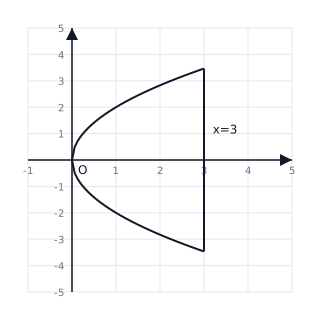
Find the area of the region bounded by the parabola and the line .
Solution:
- The parabola is symmetric about the -axis.
- The required area is bounded by to .
- Area
- Since , in the first quadrant.
- Area
- Area
- Area square units.
Explanation:
We calculate the area in the first quadrant (from to ) and double it because the parabola is symmetric across the -axis.
Problem 4:
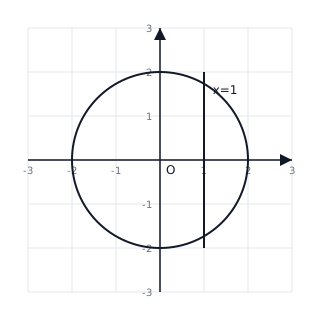
Find the area of the smaller region bounded by the circle and the line .
Solution:
- The circle has radius and center .
- The line intersects the circle at .
- Required Area
- Using the formula :
- Area
- Area
- Area
- Area square units.
Explanation:
The line divides the circle into two segments. We integrate from to the edge of the circle at and double the result due to symmetry about the -axis.