krit.club logo

Areas Related to Circles - Areas of Sector and Segment of a Circle

Grade 10CBSE

Review the key concepts, formulae, and examples before starting your quiz.

🔑Concepts

•

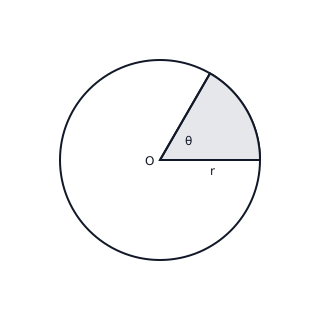
A sector is a portion of a circular region enclosed by two radii and the corresponding arc. A minor sector corresponds to an angle θ<180∘\theta < 180^\circ, while a major sector corresponds to 360∘−θ360^\circ - \theta.

Diagram of a circular sector with central angle theta and radius r
•

A segment is the region bounded by a chord and its corresponding arc. The area of the minor segment is calculated by subtracting the area of the triangle formed by the radii and the chord from the area of the sector.
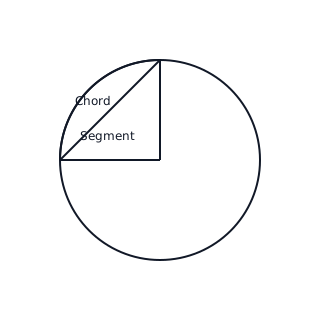
A circle showing a segment bounded by a chord and an arc
•

The length of an arc is proportional to the central angle θ\theta. It represents the distance along the curved boundary of the sector.

•

The area of a major segment is the difference between the area of the entire circle and the area of the corresponding minor segment.

📐Formulae

Area of Sector=θ360∘×πr2\text{Area of Sector} = \frac{\theta}{360^\circ} \times \pi r^2

Length of Arc(l)=θ360∘×2πr\text{Length of Arc} (l) = \frac{\theta}{360^\circ} \times 2\pi r

Area of Segment=Area of Sector−Area of Triangle\text{Area of Segment} = \text{Area of Sector} - \text{Area of Triangle}

Area of Triangle OAB=12r2sin⁡θ\text{Area of Triangle } OAB = \frac{1}{2} r^2 \sin \theta

Area of Major Sector=πr2−Area of Minor Sector\text{Area of Major Sector} = \pi r^2 - \text{Area of Minor Sector}

💡Examples

Problem 1:

Find the area of a sector of a circle with radius 6 cm6 \text{ cm} if the angle of the sector is 60∘60^\circ. (Use π=227\pi = \frac{22}{7})

Solution:

Given: r=6 cmr = 6 \text{ cm}, θ=60∘\theta = 60^\circ. Using the formula for the area of a sector: Area=θ360∘×πr2\text{Area} = \frac{\theta}{360^\circ} \times \pi r^2 Area=60360×227×6×6\text{Area} = \frac{60}{360} \times \frac{22}{7} \times 6 \times 6 Area=16×227×36\text{Area} = \frac{1}{6} \times \frac{22}{7} \times 36 Area=22×67=1327≈18.86 cm2\text{Area} = \frac{22 \times 6}{7} = \frac{132}{7} \approx 18.86 \text{ cm}^2

Explanation:

We apply the sector area formula by substituting the given radius and central angle. The fraction 60360\frac{60}{360} simplifies to 16\frac{1}{6}, which then cancels one factor of the r2r^2 term.

Problem 2:

A chord of a circle of radius 10 cm10 \text{ cm} subtends a right angle at the center. Find the area of the corresponding minor segment. (Use π=3.14\pi = 3.14)

Solution:

  1. Area of minor sector OAPBOAPB with θ=90∘\theta = 90^\circ: Area of sector=90360×3.14×10×10=14×314=78.5 cm2\text{Area of sector} = \frac{90}{360} \times 3.14 \times 10 \times 10 = \frac{1}{4} \times 314 = 78.5 \text{ cm}^2 2. Area of △OAB\triangle OAB (Right-angled triangle): Area of △=12×base×height=12×10×10=50 cm2\text{Area of } \triangle = \frac{1}{2} \times \text{base} \times \text{height} = \frac{1}{2} \times 10 \times 10 = 50 \text{ cm}^2 3. Area of minor segment: 78.5−50.028.5\begin{array}{r} 78.5 \\ - 50.0 \\ \hline 28.5 \end{array} Area of segment=28.5 cm2\text{Area of segment} = 28.5 \text{ cm}^2

Explanation:

To find the segment area, we first find the area of the quarter-circle (sector with 90∘90^\circ) and then subtract the area of the right-angled triangle formed by the radii and the chord.

Problem 3:

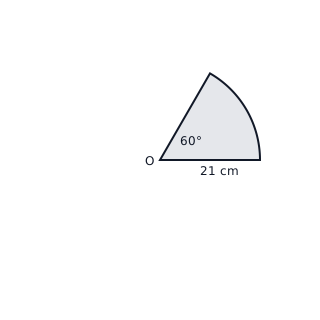
In a circle of radius 21 cm21 \text{ cm}, an arc subtends an angle of 60∘60^\circ at the centre. Find (i) the length of the arc and (ii) the area of the sector formed by the arc. (Use π=227\pi = \frac{22}{7})

Sector with radius 21 cm and angle 60 degrees

Solution:

Given: r=21 cmr = 21 \text{ cm}, θ=60∘\theta = 60^\circ

(i) Length of arc (l)=θ360∘×2πr(l) = \frac{\theta}{360^\circ} \times 2\pi r l=60360×2×227×21l = \frac{60}{360} \times 2 \times \frac{22}{7} \times 21 l=16×2×22×3l = \frac{1}{6} \times 2 \times 22 \times 3 l=22 cml = 22 \text{ cm}

(ii) Area of sector =θ360∘×πr2= \frac{\theta}{360^\circ} \times \pi r^2 Area=60360×227×21×21\text{Area} = \frac{60}{360} \times \frac{22}{7} \times 21 \times 21 Area=16×22×3×21\text{Area} = \frac{1}{6} \times 22 \times 3 \times 21 Area=11×21=231 cm2\text{Area} = 11 \times 21 = 231 \text{ cm}^2

Explanation:

To find the arc length, we use the fraction of the circumference corresponding to the central angle. For the sector area, we take the same fraction of the total area of the circle.

Problem 4:

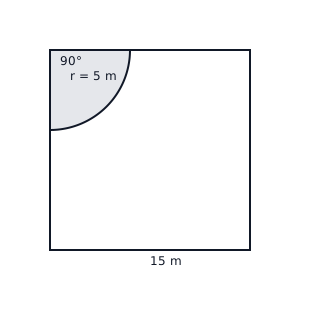
A horse is tied to a peg at one corner of a square shaped grass field of side 15 m15 \text{ m} by means of a 5 m5 \text{ m} long rope. Find the area of that part of the field in which the horse can graze. (Use π=3.14\pi = 3.14)

Square field with a quadrant sector showing grazing area

Solution:

The horse is tied at the corner of a square, so it can graze in the shape of a quadrant (sector with θ=90∘\theta = 90^\circ). Given: r=5 mr = 5 \text{ m}, θ=90∘\theta = 90^\circ

Area of Grazing=θ360∘×πr2\text{Area of Grazing} = \frac{\theta}{360^\circ} \times \pi r^2 Area=90360×3.14×5×5\text{Area} = \frac{90}{360} \times 3.14 \times 5 \times 5 Area=14×3.14×25\text{Area} = \frac{1}{4} \times 3.14 \times 25 Area=78.54=19.625 m2\text{Area} = \frac{78.5}{4} = 19.625 \text{ m}^2

Explanation:

Since the field is square, the angle at the corner is 90∘90^\circ. The length of the rope acts as the radius of the circular sector the horse can reach.