
Review the key concepts, formulae, and examples before starting your quiz.
🔑Concepts
A hydrogen fuel cell is an electrochemical cell that converts the chemical energy of a fuel (hydrogen) and an oxidizing agent (oxygen) into electricity through a pair of redox reactions. Unlike batteries, fuel cells require a continuous source of fuel and oxygen to sustain the chemical reaction.
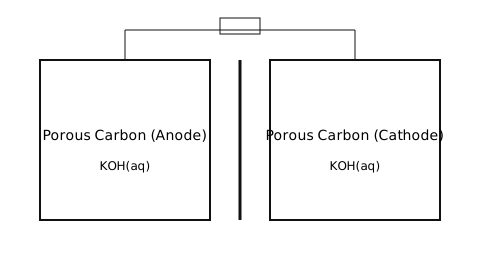
In an alkaline fuel cell, the electrolyte is typically an aqueous solution of potassium hydroxide (). At the anode (negative electrode), hydrogen gas reacts with hydroxide ions:
At the cathode (positive electrode) of an alkaline fuel cell, oxygen gas reacts with water and electrons to form hydroxide ions: This maintains the concentration of the electrolyte while producing electrical work.
The main advantages of hydrogen fuel cells include high efficiency compared to internal combustion engines and the fact that the only byproduct at the point of use is water (), making them 'zero-emission' if the hydrogen is produced sustainably.
📐Formulae
(Overall Reaction)
(Anode in Acidic Conditions)
(Cathode in Acidic Conditions)
💡Examples
Problem 1:
Calculate the standard cell potential () for a hydrogen-oxygen fuel cell operating under acidic conditions, given the standard reduction potentials: and .
Solution:
Explanation:
In a fuel cell, oxygen is reduced at the cathode and hydrogen is oxidized at the anode. The standard electrode potential for the oxygen electrode is and for the hydrogen electrode (SHE) is . Subtracting the anode potential from the cathode potential gives the total cell voltage.
Problem 2:
Write the overall balanced equation for an alkaline fuel cell and identify the species being oxidized.
Solution:
Overall equation: . The species being oxidized is .
Explanation:
During the reaction, the oxidation state of hydrogen increases from in to in . Since oxidation is the loss of electrons (or increase in oxidation state), hydrogen is the species being oxidized at the anode.
Problem 3:
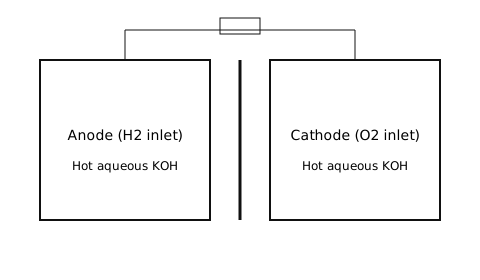
Identify the direction of electron flow and the ions moving through the electrolyte in the alkaline fuel cell shown. Write the half-equation occurring at the cathode.
Solution:
- Electrons flow from the Anode (left) to the Cathode (right) through the external circuit.
- In the electrolyte (), hydroxide ions () move from the cathode to the anode.
- Cathode half-equation:
Explanation:
In any electrochemical cell, oxidation occurs at the anode, releasing electrons which travel through the external wire to the cathode. In alkaline fuel cells, the charge carrier in the electrolyte is the ion, which migrates toward the anode to react with .
Problem 4:
Calculate the mass of water produced when g of hydrogen gas is completely reacted in a hydrogen-oxygen fuel cell.
Solution:
- The overall reaction is:
- Calculate moles of :
- From the stoichiometry, moles of produce moles of . So, .
- Calculate mass of :
Explanation:
The overall stoichiometry of the fuel cell is identical to the combustion of hydrogen. Using the molar mass of hydrogen () and water (), we find that of hydrogen yields of water.