
Review the key concepts, formulae, and examples before starting your quiz.
🔑Concepts
A Galvanic (or Voltaic) cell converts chemical energy from a spontaneous redox reaction into electrical energy. It consists of two half-cells connected by a salt bridge. Oxidation occurs at the Anode (negative terminal), and reduction occurs at the Cathode (positive terminal).
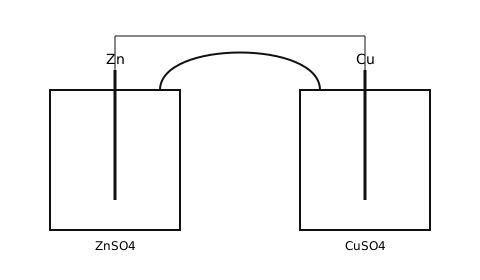
The Cell Potential () is the potential difference between the two electrodes. Under standard conditions ( concentration, ), it is calculated as , where both values are standard reduction potentials.
The Nernst Equation relates the electrode potential or cell potential to the concentration of species involved and temperature: . At , this simplifies to .
The Salt Bridge completes the circuit and maintains electrical neutrality in the half-cells by providing a path for ion migration. It prevents the accumulation of charges that would otherwise stop the flow of electrons.
📐Formulae
💡Examples
Problem 1:
Calculate the emf of the cell in which the following reaction takes place: . Given that .
Solution:
- Identify : The number of electrons transferred is .
- Apply Nernst Equation: .
- Substitute values: .
- Calculate log term: . .
- Final calculation: .
Explanation:
The Nernst equation is used here to find the potential under non-standard concentrations. Note that the concentration of is squared because its stoichiometric coefficient in the balanced equation is 2.
Problem 2:
Calculate the standard Gibbs energy () for the reaction: . Given , , and .
Solution:
- Calculate .
- Identify (since ).
- Use formula .
- .
Explanation:
The negative value of indicates that the reaction is thermodynamically spontaneous under standard conditions.
Problem 3:
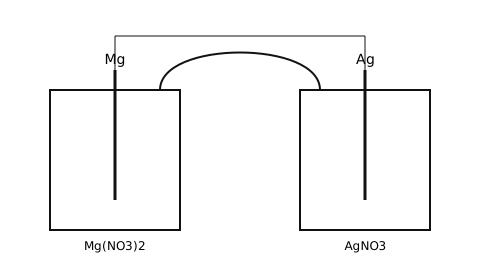
Calculate the emf of the cell represented below at : . Given and .
Solution:
-
Determine :
-
Write the cell reaction: Here, .
-
Apply Nernst Equation:
Explanation:
The standard cell potential is first calculated using reduction potentials. The Nernst equation is then used to account for non-standard concentrations, noting that the silver ion concentration is squared due to its stoichiometric coefficient.
Problem 4:
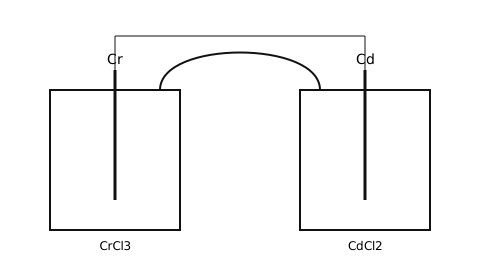
A cell is constructed with a Chromium electrode in solution and a Cadmium electrode in solution. Determine the standard cell potential and identify the cathode. Given and .
Solution:
-
Identify Cathode and Anode: The electrode with the higher reduction potential acts as the cathode. Since , the Cadmium electrode is the Cathode and Chromium is the Anode.
-
Calculate :
Explanation:
In a galvanic cell, the more positive (or less negative) reduction potential determines the cathode. The standard EMF is the difference between these potentials.