
Review the key concepts, formulae, and examples before starting your quiz.
🔑Concepts
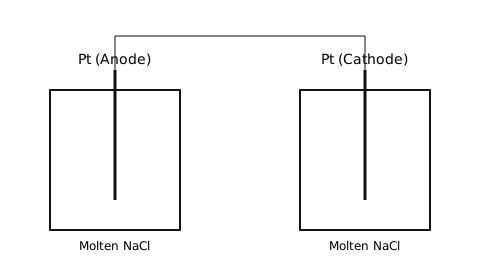
Electrolytic cells are devices where electrical energy is used to drive a non-spontaneous chemical reaction (electrolysis). In these cells, the anode is assigned a positive polarity () and the cathode a negative polarity ().
Faraday's First Law of Electrolysis states that the mass () of any substance deposited or liberated at any electrode is directly proportional to the quantity of electricity () passed through the electrolyte: or .
Faraday's Second Law of Electrolysis states that when the same quantity of electricity is passed through different electrolytes connected in series, the masses of substances produced are proportional to their chemical equivalent weights ().
The product of electrolysis depends on the nature of the material being electrolyzed and the type of electrodes used. If electrodes are inert (like Pt or Au), they do not participate in the reaction; if reactive, the electrode itself may dissolve or be deposited.
In aqueous solutions, water can also be oxidized or reduced. The species with a higher reduction potential is reduced at the cathode, and the species with a lower reduction potential (easier oxidation) is oxidized at the anode.
📐Formulae
💡Examples
Problem 1:
A solution of is electrolyzed for minutes with a current of amperes. What is the mass of copper deposited at the cathode? (Atomic mass of )
Solution:
Given: , . Charge . The cathode reaction is . To deposit of , () is required. Mass .
Explanation:
We first calculate the total charge in Coulombs. Using the stoichiometry of the reduction reaction (), we apply Faraday's Law to find the mass deposited.
Problem 2:
During the electrolysis of molten , how many Coulombs are required to produce of ? (Atomic mass of )
Solution:
The reaction at the cathode is . Moles of . Since of requires of charge, requires . Total charge .
Explanation:
The number of moles of electrons required is calculated based on the valency of Aluminum (). Multiplying the moles of substance by and Faraday's constant gives the total charge.
Problem 3:
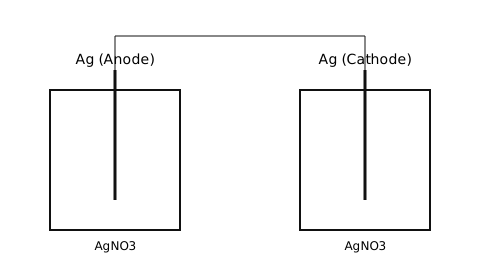
A current of is passed through a solution of silver nitrate () for minutes. Calculate the mass of silver deposited at the cathode. (Atomic mass of , )
Solution:
- Calculate total charge ():
- Write the cathode reaction: This shows of () deposits of .
- Calculate mass ():
Explanation:
The quantity of electricity is found by multiplying current and time in seconds. Using Faraday's constant and the stoichiometry of the silver ion reduction, the mass is derived.
Problem 4:
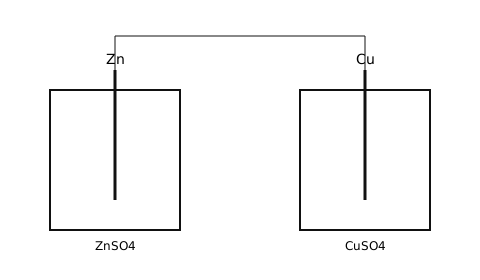
Two cells containing and are connected in series. If of Zinc is deposited in the first cell, calculate the mass of Copper deposited in the second cell. (Atomic mass: , )
Solution:
According to Faraday's Second Law:
- Calculate Equivalent Weights ():
- Substitute values:
Explanation:
Since the cells are in series, the same charge passes through both. The ratio of the masses of zinc and copper deposited equals the ratio of their chemical equivalent weights.