
Review the key concepts, formulae, and examples before starting your quiz.
🔑Concepts
A Galvanic (Voltaic) cell converts chemical energy from a spontaneous redox reaction into electrical energy. It consists of two half-cells connected by a salt bridge. The anode is the electrode where oxidation occurs (negative polarity), and the cathode is where reduction occurs (positive polarity).
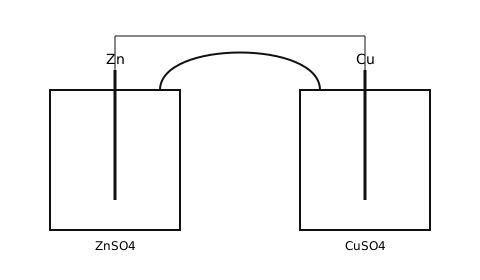
The Salt Bridge completes the electrical circuit and maintains electrical neutrality in the half-cells by allowing the migration of ions. It typically contains an inert electrolyte like or in agar-agar gel.
Electrode Potential is the potential difference established between the metal electrode and its ion solution. Under standard conditions ( concentration, ), it is called Standard Electrode Potential ().
The Cell EMF () is the potential difference between the two electrodes of the cell when no current is drawn. It is calculated as using reduction potentials.
📐Formulae
💡Examples
Problem 1:
Calculate the emf of the following cell at : . Given and .
Solution:
- Calculate : .
- Identify : For and , .
- Apply Nernst Equation: .
- Substitute values: .
- .
Explanation:
The standard cell potential is calculated first. Since the concentrations are not , the Nernst equation is used to find the actual cell potential. The reaction quotient is the ratio of product ion concentration to reactant ion concentration.
Problem 2:
Calculate the standard Gibbs energy for the reaction: . Given and .
Solution:
- Identify : In this redox reaction, electrons are transferred, so .
- Use the formula: .
- .
- .
Explanation:
Standard Gibbs energy is directly proportional to the standard cell potential. The negative sign indicates that the reaction is thermodynamically spontaneous under standard conditions.
Problem 3:
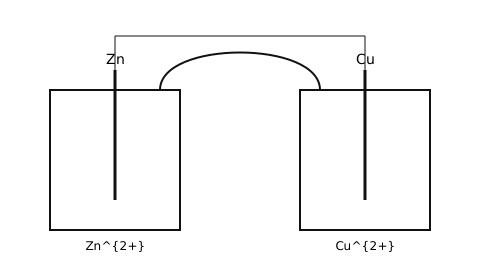
Calculate the equilibrium constant () for the reaction occurring in a Daniel cell at if the standard cell potential is . The reaction is: Use the relation .
Solution:
- Identify the number of electrons transferred: for the system.
- Use the Nernst-derived formula for equilibrium:
- Calculate the value:
- Find the antilog:
Explanation:
At equilibrium, , which allows us to relate the standard cell potential directly to the equilibrium constant of the redox reaction.
Problem 4:
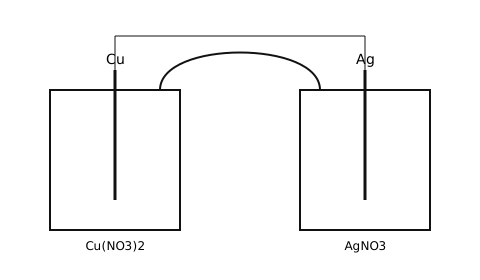
A silver-copper cell is constructed. Given and . Write the cell notation and calculate the standard EMF of the cell.
Solution:
- Compare reduction potentials: , so Silver acts as the cathode and Copper as the anode.
- Write the cell representation:
- Calculate :
- Final result: The standard EMF is .
Explanation:
In a galvanic cell, the electrode with the higher reduction potential undergoes reduction and is designated as the cathode.