
Review the key concepts, formulae, and examples before starting your quiz.
🔑Concepts
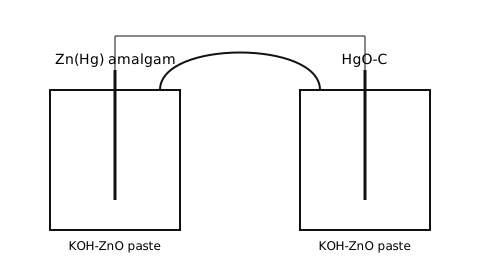
Primary batteries are non-rechargeable cells where the reaction occurs only once. A common example is the Mercury Cell, which provides a constant voltage of because the electrolyte concentration does not change during its life.
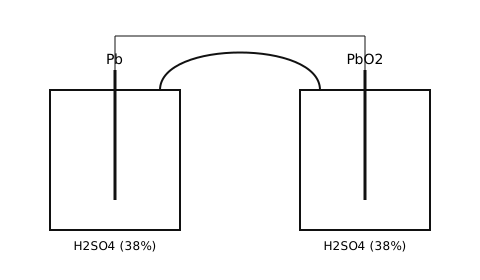
Secondary batteries are rechargeable because the chemical reactions can be reversed by passing an external electric current. In a Lead Storage Battery, the density of decreases during discharge and increases during charging.
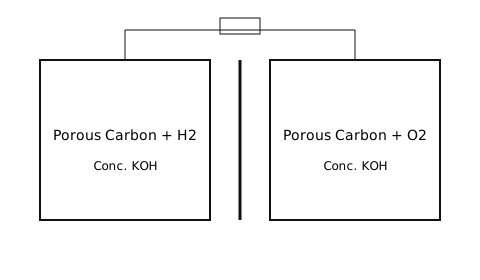
Fuel cells are galvanic cells designed to convert the chemical energy of fuels like , , or directly into electrical energy. The fuel cell is highly efficient () and pollution-free.
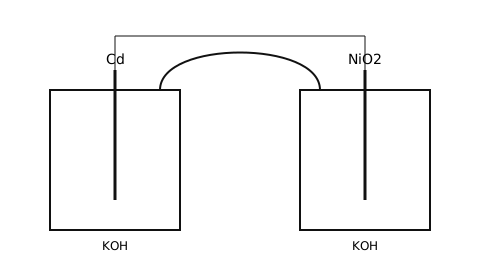
The Nickel-Cadmium (Ni-Cd) cell is a secondary cell with a longer life than lead storage batteries but is more expensive to manufacture. The overall reaction is: .
📐Formulae
💡Examples
Problem 1:
Write the cathode and anode reactions that occur during the discharging of a Lead-storage battery.
Solution:
Anode: Cathode:
Explanation:
During discharging, the lead-storage battery acts as a galvanic cell. Lead is oxidized at the anode, and Lead dioxide is reduced at the cathode. Both reactions produce , which sticks to the electrodes.
Problem 2:
Calculate the theoretical efficiency of a fuel cell if for is and is .
Solution:
Efficiency
Explanation:
The efficiency of a fuel cell is defined as the ratio of the maximum useful work (Gibbs Free Energy change) to the total heat of combustion (Enthalpy change).
Problem 3:
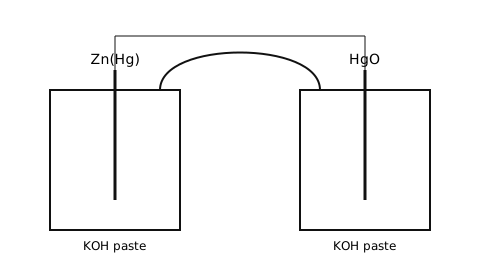
Identify the anode and cathode materials in a standard Mercury cell and write the half-cell reaction occurring at the anode.
Solution:
In a Mercury cell: Anode: Zinc-Mercury amalgam () Cathode: A paste of Mercury(II) oxide () and carbon.
Anode reaction:
Explanation:
The Mercury cell is a primary cell. The anode involves the oxidation of Zinc in the presence of basic electrolyte ions.
Problem 4:
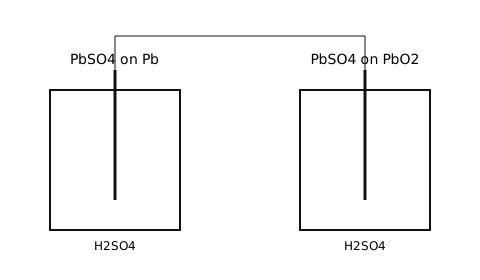
Describe the chemical changes at the cathode during the charging process of a Lead storage battery.
Solution:
During charging, the lead storage battery acts as an electrolytic cell. The discharge reactions are reversed.
At the Cathode (Reduction of to ):
Note: The electrode that was the anode during discharge becomes the cathode during charging.
Explanation:
Charging reverses the chemical consumption of . Electrons are supplied by an external source to reduce back to metallic Lead at the negative electrode.