
Review the key concepts, formulae, and examples before starting your quiz.
🔑Concepts
A hydrogen fuel cell is an electrochemical cell that converts the chemical energy of a fuel (hydrogen) and an oxidizing agent (oxygen) into electricity through a pair of redox reactions. Unlike batteries, they do not run down or need recharging as long as fuel and oxygen are supplied.
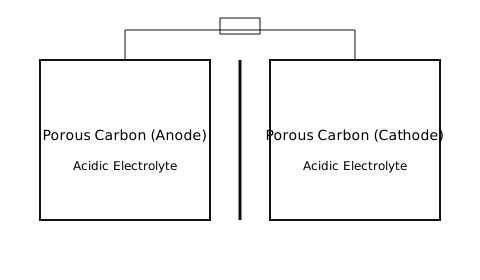
At the anode (negative electrode), hydrogen gas undergoes oxidation. The hydrogen molecules lose electrons to form hydrogen ions: . These electrons flow through the external circuit to create an electric current.
At the cathode (positive electrode), oxygen gas undergoes reduction. Oxygen molecules react with the hydrogen ions migrating through the electrolyte and the electrons arriving from the external circuit: .
The overall cell reaction is the combustion of hydrogen to form water: . The only byproduct is water, making it a 'clean' energy source with no carbon emissions at the point of use.
Advantages of fuel cells include high efficiency, silent operation, and lack of pollutants like or . Disadvantages include the difficulty of storing hydrogen gas safely and the high cost of catalysts like platinum.
📐Formulae
💡Examples
Problem 1:
Calculate the total number of electrons transferred when mol of hydrogen gas () is completely reacted in a fuel cell.
Solution:
From the anode half-equation, moles of produce moles of electrons (). The total number of electrons is electrons.
Explanation:
The oxidation half-equation is . This shows a molar ratio between and . Therefore, moles of release moles of electrons. Using Avogadro's constant (), we find the total particle count.
Problem 2:
State the change in the oxidation state of oxygen in a hydrogen fuel cell reaction.
Solution:
The oxidation state of oxygen changes from in to in .
Explanation:
In its elemental form (), the oxidation state of oxygen is . In the product water (), oxygen is more electronegative than hydrogen and takes an oxidation state of . Because the oxidation state decreases, oxygen undergoes reduction.
Problem 3:
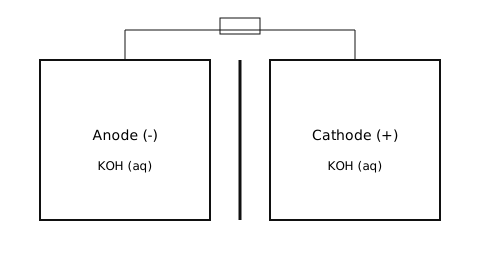
In a specific hydrogen fuel cell design using an alkaline electrolyte, identify the reaction occurring at the anode and determine the volume of required at r.t.p to produce mol of electrons.
Solution:
- In alkaline conditions, the anode reaction is:
- From the stoichiometry, mol of produces mol of electrons.
- To produce mol of electrons: mol of .
- Volume at r.t.p: .
Explanation:
The relationship between moles of gas and moles of electrons is determined by the balanced half-equation. In all hydrogen fuel cells, mole of always releases moles of electrons.
Problem 4:
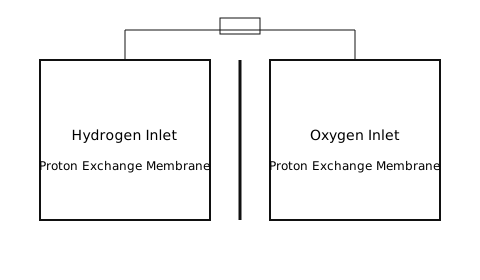
During the operation of the fuel cell shown, g of oxygen gas is consumed at the cathode. Calculate the mass of water produced during this process.
Solution:
- Molar mass of g/mol. Moles of used: mol.
- From the overall equation , the ratio of to is .
- Moles of produced: mol.
- Mass of : .
Explanation:
Using the balanced overall equation for the fuel cell, we apply stoichiometry to relate the mass of the reactant oxygen to the mass of the product water.